
Table of Contents
- Why Your Historic Home Needs Cooling Now (Not Later)
- Why Retrofitting Central HVAC Is More Destructive (and Expensive) Than You Think
- The 3-Inch Solution: Why Ductless Systems Are Built for Vintage Homes
- Room-by-Room Comfort: The Energy Savings You Can’t Get With Central Air
- How Federal and Local Rebates Make Ductless Systems Surprisingly Affordable
- Success Stories: Vintage Homes Transformed Without Compromise
- Final Thoughts
- References
The 2021 heat dome that pushed Portland temperatures to a record-breaking 116°F wasn’t just uncomfortable—it was dangerous. For owners of the Pacific Northwest’s beautiful vintage homes, from Queen Anne Victorians to Craftsman Bungalows, that summer exposed a critical vulnerability: homes built before air conditioning weren’t designed to handle extreme heat.
If you own a pre-1950s home in the Portland metro area or Vancouver metro area, you’re likely facing a difficult question: how do you add modern cooling and efficient heating without destroying the architectural character you love? The traditional answer—retrofitting central HVAC—often means tearing into plaster walls, sacrificing closets, and building bulky soffits that ruin original ceiling lines.
There’s a better solution. Ductless mini-split heat pumps offer efficient cooling and heating while preserving your home’s historic integrity. In this guide, we’ll break down why ductless systems are the superior choice for Pacific Northwest vintage homes, comparing installation impact, energy efficiency, indoor air quality, and long-term costs. Plus, we’ll show you how federal and local incentives can make this upgrade surprisingly affordable.
Why Your Historic Home Needs Cooling Now (Not Later)
The Pacific Northwest climate has fundamentally changed, making air conditioning a necessity rather than a luxury for vintage homes. Your beautiful historic property was designed with clever cooling strategies that worked brilliantly—until recently. Those thick walls, high ceilings, and strategically placed windows were meant to capture cross-breezes and leverage thermal mass when summer temperatures rarely exceeded 90°F.
But the baseline has shifted dramatically. The 2021 heat dome event didn’t just break records—it shattered assumptions about what “normal” Pacific Northwest summers look like. When Portland hit 116°F with nighttime temperatures that refused to drop, traditional passive cooling methods simply couldn’t keep up. High ceilings and thick walls can only do so much when the heat is relentless and there’s no cool nighttime air to flush through the house.
The data tells a stark story. According to the U.S. Energy Information Administration, air conditioning adoption has surged across the Seattle–Portland corridor following recent extreme heat events. What was once considered an unnecessary luxury is now recognized as essential infrastructure. Climate projections suggest these extreme heat events will become more frequent, not less—making the question not whether to add cooling, but how to do it right.
Vintage homes face unique vulnerabilities during heat waves. Pre-1950s construction methods like balloon framing, lath and plaster walls, and minimal insulation create buildings that are particularly susceptible to heat retention once temperatures climb. That thermal mass that keeps your home comfortable in spring becomes a liability in extreme summer heat, slowly absorbing and radiating warmth long after the sun goes down.
The challenge for historic homeowners is finding a cooling solution that doesn’t compromise the architectural features that make these homes special. Your home survived decades without air conditioning—but the climate it was built for no longer exists.
“Your home survived decades without air conditioning—but the climate it was built for no longer exists.”
Actionable Tip: Assess Your Home’s Heat Risk
- Note which rooms stay hottest during summer afternoons and evenings.
- Track indoor temperatures during heat waves to understand how long heat lingers at night.
- Consider how much of your home you actually use daily—this will matter later for zoning and energy savings.
Why Retrofitting Central HVAC Is More Destructive (and Expensive) Than You Think
Installing central air in a home without existing ductwork isn’t just an HVAC project—it’s major construction that permanently alters your home’s structure and character. Many homeowners discover this reality only after contractors start opening walls and presenting “unforeseen complications.”
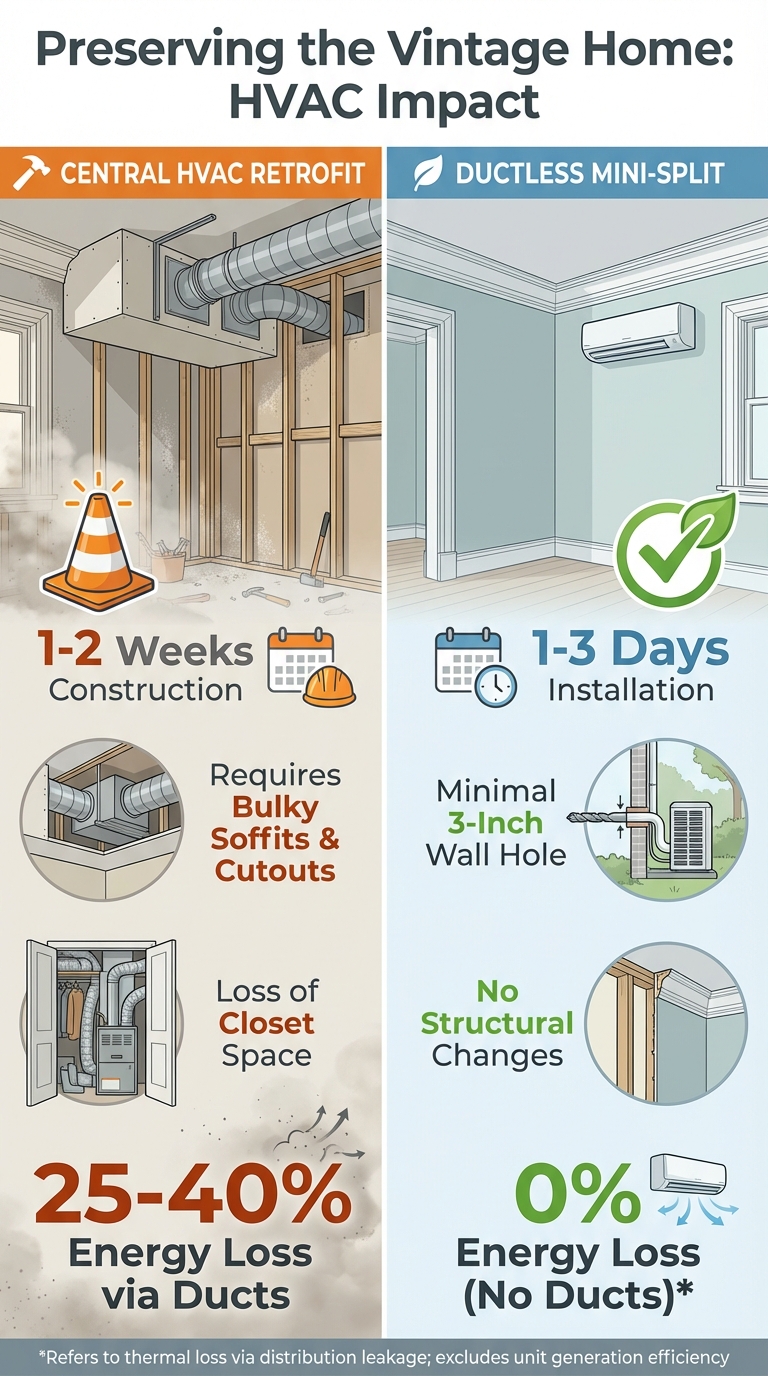
The visual comparison above illustrates what many vintage homeowners learn the hard way: central air retrofits require far more than just installing equipment.
The Soffit Problem
Central air requires 6–12 inch ducts to move conditioned air throughout your home. In a vintage property with 9-foot ceilings and original crown molding, this creates an impossible geometry problem. Contractors must build bulkheads (also called “soffits”) that box in the ductwork, destroying those beautiful ceiling lines you love. That ornate crown molding? It gets interrupted or removed entirely. Those coffered ceilings or decorative plaster details? Covered up by functional but aesthetically brutal rectangular boxes.
Closet Sacrifice
One of the most common retrofit strategies involves eliminating stacked closets on the first and second floors to create vertical duct chases. This isn’t a temporary inconvenience—it’s a permanent loss of valuable storage space in homes that already have limited closet capacity compared to modern construction. For many vintage homeowners, this trade-off alone makes central air a non-starter.
Structural Damage Risks
Cutting into lath and plaster walls isn’t like working with modern drywall. Plaster is brittle, heavy, and interconnected—cutting large vents for supply registers can crack entire wall sections, sometimes propagating damage far beyond the immediate work area. The repair work required to make these modifications invisible is expensive and often imperfect.
Balloon framing, common in Victorian-era homes, presents additional complications. While these continuous studs from foundation to roof make cable runs easy, they lack the horizontal fire-stops required by modern building codes when installing duct chases. Bringing your system up to code requires expensive structural modifications that compromise original framing.
The 25–40% Energy Waste Problem
Even if you successfully navigate all these structural challenges, you inherit a permanent efficiency penalty. The U.S. Department of Energy confirms that typical duct systems lose 25–40% of heating and cooling energy through leaks and poor connections. In a retrofit scenario, where ducts must be maneuvered through tight existing cavities around original framing, achieving a perfectly sealed system is exponentially harder than in new construction.
This problem compounds in Pacific Northwest homes with unconditioned attics. During summer, your attic can reach 130°F. Cool air traveling through ducts in this environment gains significant heat before reaching your living spaces—meaning your AC works harder and your bills climb higher, even if the system is functioning “normally.”
The National Park Service’s Preservation Brief 24 emphasizes that mechanical upgrades should be reversible and non-damaging to historic fabric—standards that central air retrofits routinely violate.
The Real Cost
Beyond equipment and basic installation labor, central air retrofits include:
- Construction labor (1–2 weeks minimum of active work)
- Extensive drywall repair and painting throughout affected areas
- Potential mold remediation if wall cavities contain moisture or organic material
- Lost square footage value from sacrificed closets and lowered ceilings
- Ongoing maintenance costs for ductwork cleaning and sealing
When you add these factors together, the true cost of retrofitting central air often doubles or triples the initial equipment estimate.
Actionable Tip: Question “Too-Good-To-Be-True” Central Air Quotes
When comparing bids:
- Ask specifically what walls, ceilings, or closets will be opened or altered.
- Request separate line items for drywall repair, painting, and trim restoration.
- Confirm whether the price includes bringing framing and fire-stopping up to current code.
The 3-Inch Solution: Why Ductless Systems Are Built for Vintage Homes
Ductless mini-split technology delivers modern comfort while respecting the architectural integrity of historic Pacific Northwest homes. The system’s elegance lies in its simplicity: an outdoor compressor unit connects to indoor air handling units through a narrow conduit containing refrigerant lines, power cable, and condensate drain—all of which fits through a single 3-inch hole in your exterior wall.
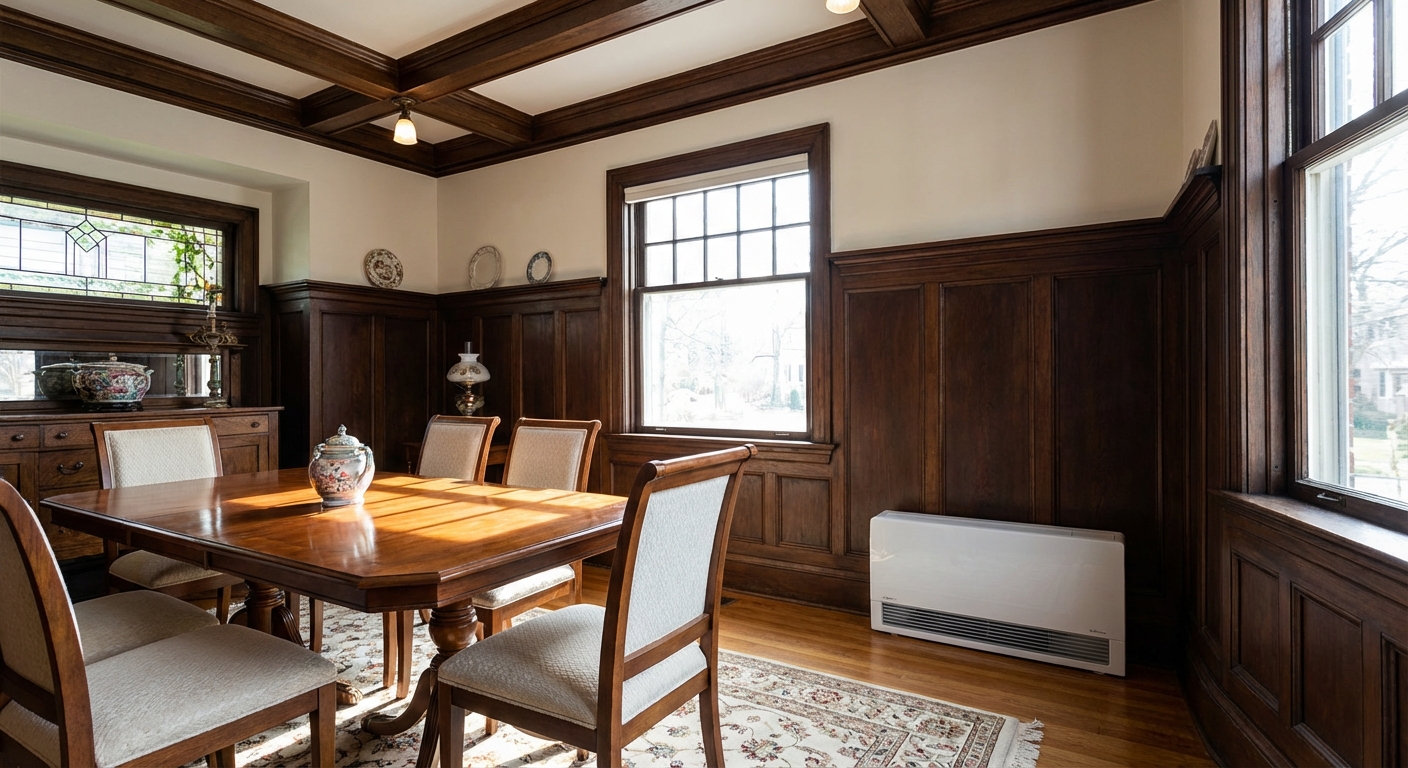
Minimal Installation Footprint
The contrast with central air couldn’t be starker. Ductless systems require no cutting of floor joists, no tearing down plaster walls, and no sacrificing closets. That 3-inch penetration is the only permanent modification to your home’s structure—and it’s fully reversible if you ever decide to remove the system. This aligns perfectly with historic preservation principles that emphasize maintaining the ability to restore original conditions.
How the System Works
The split design separates the noisy compressor (which stays outside) from the quiet air delivery units (which mount inside your living spaces). The outdoor unit can be placed on the ground, on a concrete pad, or wall-mounted, depending on your property’s layout and aesthetic preferences. Indoor units come in multiple configurations—wall-mounted, ceiling cassettes, or floor-mounted—allowing you to work around original woodwork, wainscoting, and architectural details.
Modern inverter technology represents a quantum leap over traditional HVAC compressors. Instead of the “stop-and-go” cycling of conventional systems, inverter-driven compressors ramp up or down based on real-time demand. This eliminates the high-energy startup spikes that characterize older technology while maintaining more consistent temperatures and using less electricity.
Installation Timeline
A complete ductless system installation typically takes 1–3 days, compared to 1–2 weeks (or more) for central air retrofits. Better yet, there’s no drywall repair, no painting, and no construction cleanup required. Your home remains livable throughout the process—a significant advantage if you’re trying to maintain your daily routine or avoid displacing your family during installation.
The Installation Process
- Outdoor Unit Placement: The compressor is positioned and secured on a ground pad or wall mount.
- Indoor Unit Mounting: Air handlers are installed in selected rooms using existing wall studs or ceiling joists.
- Line Set Connection: A single penetration through the exterior wall for each indoor unit accommodates all necessary connections.
- System Testing: Refrigerant lines are pressurized, electrical connections verified, and the system balanced.
Architectural Flexibility
One of the greatest advantages for vintage homeowners is the system’s adaptability to your home’s unique character. Wall-mounted units can be positioned to avoid interfering with original picture rails or chair rails. Ceiling cassettes can integrate into existing ceiling coffers or be positioned between decorative beams. Floor-mounted units can replace bulky baseboard heaters while taking up less visual space and providing better air circulation.
The system’s reversibility means you’re not making a permanent commitment that future owners—or future you—might regret. Original ceiling heights remain intact. Crown molding stays untouched. Architectural details that define your home’s character remain visible and preserved.
Zero Distribution Loss
Perhaps the most important technical advantage: point-of-use delivery means 100% of the conditioned air reaches your living spaces. There’s no thermal bridging through unconditioned attics, no leakage through imperfect duct connections, and no energy wasted moving air through long runs of metal ductwork. The efficiency you pay for in the equipment is the efficiency you receive in your home.
Actionable Tip: Plan Your Zones Around How You Live
- Group spaces you use at the same time (like bedrooms) into the same ductless zones.
- Give home offices or studios their own zone so you can heat or cool them only when in use.
- Consider future use of spaces (finished attic, ADU, or basement) when sizing outdoor units.
Room-by-Room Comfort: The Energy Savings You Can’t Get With Central Air
Ductless systems deliver superior energy efficiency and personalized comfort through zone control technology that fundamentally changes how you think about heating and cooling your home.
SEER2 Ratings: The Efficiency Gap
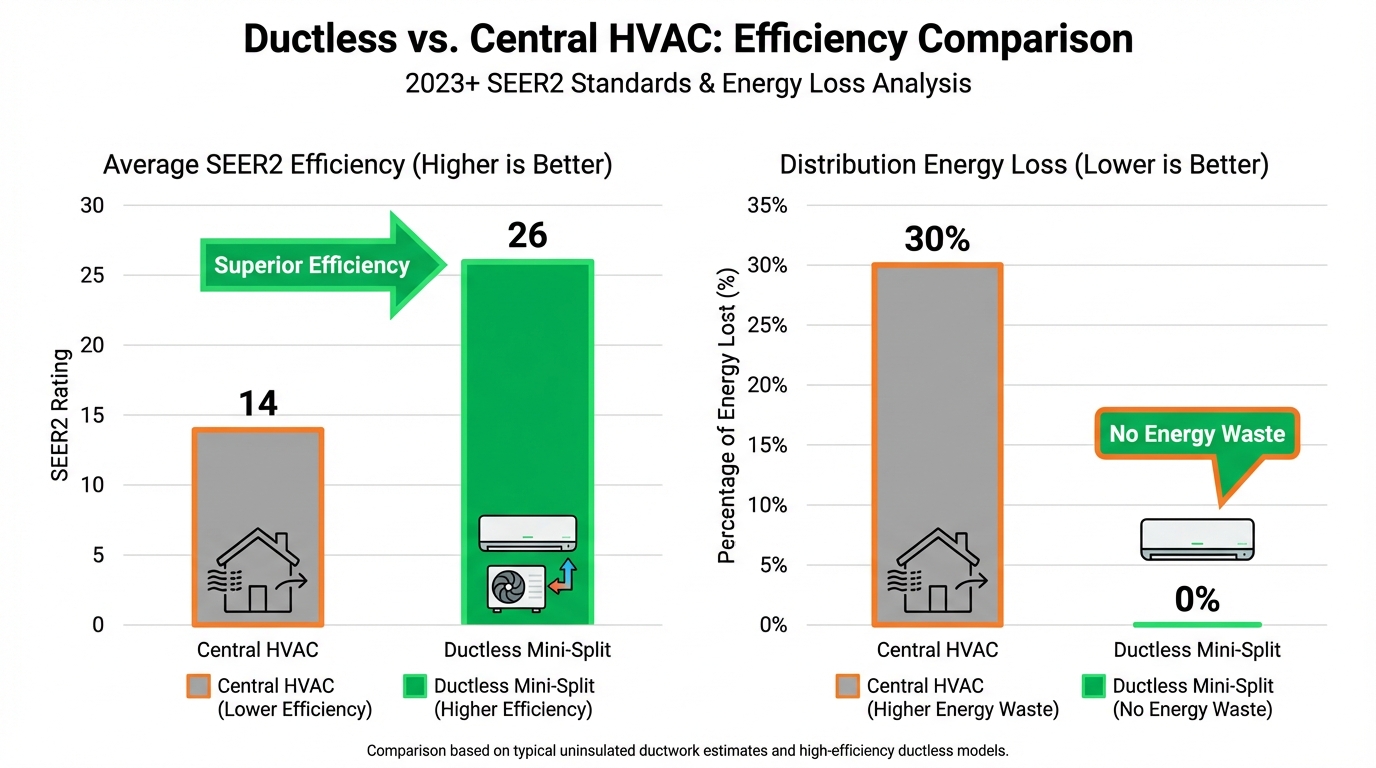
When comparing HVAC systems, SEER2 (Seasonal Energy Efficiency Ratio 2) ratings tell the story. Central HVAC retrofits typically achieve 13–16 SEER2—respectable, but limited by the fundamental inefficiency of duct-based distribution. Ductless systems, by contrast, range from 20–33+ SEER2. This isn’t a marginal improvement—it’s a different class of performance entirely.
The chart above visualizes this efficiency gap. Even before accounting for duct loss, ductless systems operate at significantly higher efficiency levels. When you factor in the 25–40% energy waste from typical duct systems, the real-world performance difference becomes even more dramatic.
Zone Control: Heating and Cooling Only What You Use
Central air systems operate on a single-thermostat model: one temperature setting for the entire house. This “one size fits all” approach wastes energy conditioning spaces you’re not using and can’t accommodate different temperature preferences in different rooms.
Ductless systems eliminate this limitation. Each indoor unit operates independently, creating separate zones with individual temperature control. The practical implications are significant:
- Bedroom zones can be kept cooler at night without overcooling the rest of the house.
- Home offices receive cooling during work hours while other spaces remain off.
- Guest rooms stay at minimal settings until needed.
- Living spaces can maintain different temperatures based on sun exposure and usage patterns.
Real-World Energy Savings
Consider a 1925 Craftsman bungalow in Northeast Portland (detailed further in our case study section). After installing a 4-zone ductless system, the homeowners tracked their cooling costs throughout their first summer. Despite the high SEER rating equipment being more expensive upfront, their monthly cooling costs averaged just $35—a remarkable figure given Portland’s increasingly hot summers.
This performance stems from two factors: the system’s high efficiency and the ability to cool only occupied rooms. During work hours, only the home office unit runs. In the evening, the system focuses on living areas and bedrooms while leaving the office off. This selective operation dramatically reduces overall energy consumption compared to a central system that must condition the entire house anytime any room needs cooling.
Heating Efficiency for Pacific Northwest Winters
The same technology that provides efficient cooling excels at heating. Modern cold-climate heat pumps extract heat from outdoor air even when temperatures drop to -15°F—well below anything the Pacific Northwest typically experiences. This makes ductless systems viable as primary heat sources, not just supplementary cooling.
For homes currently heated with expensive electric baseboard or ceiling cable heat, the savings potential is enormous. Ductless heat pumps can reduce heating costs by 50–60% compared to electric resistance heating. The technology is fundamentally more efficient: instead of converting electricity directly to heat (like baseboard heaters), heat pumps move existing heat from outdoors to indoors—a process that delivers 3–4 units of heat for every unit of electricity consumed.
Smart Controls and Optimization
Modern ductless systems include Wi-Fi connectivity and smartphone apps that enable scheduling and remote control. You can program temperature setbacks for when you’re away, adjust settings from work if your schedule changes, or set different programs for weekdays versus weekends. This level of control, combined with the system’s inherent efficiency, maximizes energy savings without sacrificing comfort.
Acoustic Performance: Whisper-Quiet Operation
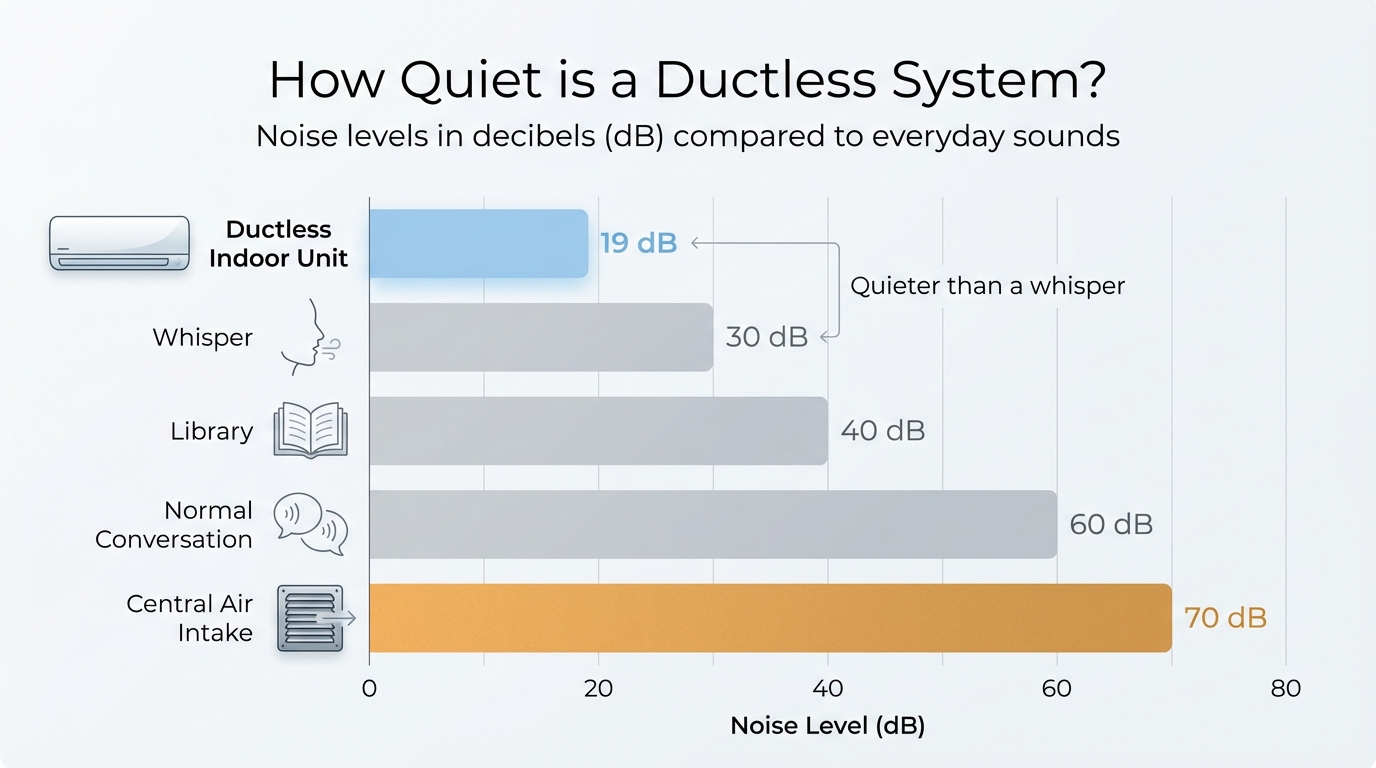
Vintage homes often lack the sound insulation of modern construction, making HVAC noise a significant quality-of-life consideration. The acoustic difference between central air and ductless systems is substantial and immediately noticeable.
Central air systems with their intake and furnace components typically operate at 60–75 decibels—roughly equivalent to normal conversation volume or background music. While not deafening, this constant hum becomes the ambient sound in your home whenever the system runs.
Ductless indoor units, by contrast, operate at 19–25 decibels—quieter than a whisper (30 dB) and barely perceptible even in silent rooms. This makes them ideal for bedrooms, home offices, or any space where noise would be disruptive. The outdoor compressor does generate noise, but it’s located outside where it won’t disturb indoor activities.
Indoor Air Quality Benefits
Pacific Northwest residents increasingly face seasonal wildfire smoke—a reality that makes indoor air quality more critical than ever. Ductless systems offer significant IAQ advantages over central air:
Multi-stage filtration: Indoor units include sophisticated filtration systems that capture dust, pollen, mold spores, and microscopic particles. Many models feature HEPA-grade filters or electrostatic filtration that removes particles down to 0.3 microns—small enough to capture many viruses and bacteria.
Accessible maintenance: Ductless filters are easily accessible on the front panel of each unit, making regular cleaning simple. This contrasts sharply with central ductwork, which can become a reservoir for allergens and requires professional cleaning to maintain.
No cavity circulation: Central air systems circulate air that’s been drawn through wall cavities and ductwork that may contain dust, insulation fibers, or mold growth from decades of use. Ductless systems draw air directly from the living space, filter it, condition it, and return it—eliminating this contamination pathway.
For vintage homeowners dealing with seasonal allergies or respiratory sensitivities, these IAQ improvements often prove as valuable as the cooling itself.
How Federal and Local Rebates Make Ductless Systems Surprisingly Affordable
Substantial government incentives available in Oregon and Washington significantly offset the upfront cost of ductless mini-split installation, making this high-efficiency technology more accessible than many homeowners realize.
Federal Incentives: The Inflation Reduction Act
The IRA’s 25C tax credit provides a powerful financial incentive for heat pump installations. Homeowners can claim 30% of the total project cost, up to $2,000 annually, for qualified heat pump systems. This credit applies to both equipment and installation labor—a significant advantage over previous incentive programs that covered only equipment costs.
The application process is straightforward: your HVAC contractor provides documentation showing the system meets efficiency requirements, and you claim the credit when filing your federal taxes for the year the installation was completed. The credit directly reduces your tax liability dollar-for-dollar, making it more valuable than a deduction.
Oregon-Specific Incentives
Portland metro area homeowners benefit from the Energy Trust of Oregon’s cash incentive programs. These rebates specifically target homes replacing inefficient electric resistance heating (baseboards or ceiling cable heat) with high-efficiency ductless systems.
Rebate amounts scale based on system efficiency and size, with higher-efficiency systems qualifying for larger incentives. The Energy Trust maintains a list of qualified contractors who can streamline the application process, ensuring you receive all available incentives. Unlike tax credits that require waiting until tax season, these are point-of-sale rebates that reduce your upfront cost immediately.
Washington-Specific Incentives
Vancouver and Clark County residents can access rebates through Clark Public Utilities, ranging from $200 to $1,000 depending on the system type and heating source being displaced. The program offers enhanced incentives for income-qualified households and can be combined with federal tax credits—meaning you’re not choosing between programs but stacking benefits.
Clark Public Utilities also provides additional incentives for homes meeting specific efficiency criteria or replacing particularly inefficient heating systems. The utility’s online rebate calculator helps you estimate your specific incentive amount based on your current heating system and planned upgrade.
Cost Comparison: The Real Numbers
Let’s break down the actual costs with incentives included:
Ductless System (Per Zone):
- Base cost: $3,000–$5,000 (equipment + installation)
- Federal tax credit (30%): -$900 to -$1,500
- State/local rebates: -$200 to -$1,000
- Net cost: $1,900–$3,800 per zone
Central Air Retrofit (Whole House):
- Equipment: $8,000–$12,000
- Construction labor: $5,000–$10,000
- Drywall repair and painting: $2,000–$5,000
- Lost closet space value: Variable
- Total cost: $15,000–$30,000+
When you factor in the construction costs that central air requires—work that ductless systems avoid entirely—the price comparison shifts dramatically. A 3–4 zone ductless system that covers the same living space as a central air retrofit costs 40–50% less after incentives, while avoiding all the structural modifications and preservation concerns.
Long-Term ROI Factors
Beyond the lower upfront cost, ductless systems deliver ongoing financial benefits:
- Lower utility bills from superior efficiency and zone control
- No duct maintenance costs—no cleaning or sealing required
- Increased home value from modern comfort without compromising historic character
- Avoided repair costs from structural modifications that central air would require
For homes currently heated with electric baseboards, the heating cost savings alone can pay back the system investment within 5–7 years, even before accounting for cooling benefits.
Maximizing Your Incentives
To capture all available incentives:
- Work with qualified contractors familiar with incentive programs.
- Document your existing heating system before removal.
- Ensure the new system meets all efficiency requirements.
- Submit rebate applications promptly after installation.
- Retain all documentation for tax filing.
Many HVAC contractors, including Sarkinen Heating & Cooling, handle the incentive paperwork as part of their service, ensuring you don’t miss any available benefits due to application errors or missed deadlines.
Actionable Tip: Bring Incentive Questions to Your Estimate
When you schedule a quote, ask the contractor to:
- Price out at least one high-efficiency option that qualifies for maximum incentives.
- Show your after-rebate, after-tax-credit cost in writing.
- Estimate your monthly savings compared to your existing heating and cooling setup.
Success Stories: Vintage Homes Transformed Without Compromise
Real-world examples demonstrate how ductless systems solve complex comfort challenges in Pacific Northwest historic homes while preserving the architectural features that make these properties special.
The 1925 Craftsman Bungalow (Northeast Portland)
This quintessential Portland home embodied both the charm and challenges of vintage construction. The original oil furnace had been removed decades earlier, leaving the home dependent on inefficient electric baseboard heaters that made winter heating costs painful. With no existing ductwork and the owner’s absolute refusal to compromise the home’s 9-foot box-beam ceilings, cooling seemed impossible without major renovations.
The solution proved elegant: a 4-zone ductless system that worked with the home’s architecture rather than against it. A wall-mounted unit in the living room provided primary cooling for the main floor’s open layout. Two bedroom units ensured comfortable sleeping temperatures. Most innovative was the floor-mounted unit in the dining room, which replaced a bulky baseboard heater while taking up less visual space and providing both heating and cooling.
The results exceeded expectations. All original woodwork—including the intricate ceiling beams and built-in cabinetry that define Craftsman style—remained untouched. The home’s architectural integrity was completely preserved. Summer cooling costs averaged just $35 per month despite increasingly hot Portland summers, thanks to the system’s high SEER rating and the ability to cool only occupied rooms. Winter heating costs dropped by 50% compared to the old baseboard heaters.
Installation took just two days with zero structural modifications. The homeowners continued their daily routines throughout the installation, a stark contrast to the weeks of disruption that central air would have required.
The Mid-Century Modern Ranch (Vancouver, Washington)
This 1960s ranch presented a different set of challenges common to mid-century construction. The home featured radiant ceiling heat—electrical wires embedded directly in the plaster ceiling. This system was failing after decades of service, and the home had zero cooling capacity. The heat waves of recent summers had become unbearable.
Conventional solutions faced immediate obstacles. The flat roof design—characteristic of mid-century modern architecture—made attic duct installation impossible without building an entirely new roof structure. The ceiling plaster contained asbestos, meaning any cutting or disturbance would trigger expensive abatement requirements. Replacing the radiant heat would have required either tearing out all the ceilings or accepting a patchwork repair that would never function properly.
The ductless solution bypassed all these complications. The heat pump system provided both heating and cooling without requiring any ceiling penetration. The failing radiant system could simply be abandoned in place—no asbestos abatement, no ceiling demolition, no disruption to the home’s clean mid-century lines.
The financial benefits multiplied. The homeowners qualified for both federal tax credits and Clark Public Utilities rebates. By avoiding asbestos abatement costs alone, they saved thousands of dollars beyond the installation itself. The system’s efficiency delivered a 65% improvement over the old radiant heat, dramatically reducing monthly utility bills.
Key Patterns Across Both Projects
These case studies reveal consistent advantages that apply broadly to vintage home upgrades:
- Preservation first: Ductless systems respect the architectural features that make historic homes valuable—whether that’s Craftsman woodwork or mid-century minimalism.
- Problem solving: Rather than forcing homeowners to compromise between comfort and character, ductless technology provides solutions to problems that central air simply can’t address.
- Speed and minimal disruption: Installation timelines measured in days rather than weeks, with no need to relocate during construction or extensive post-installation cleanup.
- Financial viability: The combination of lower installation costs, substantial incentives, and ongoing energy savings makes ductless systems economically superior to central air retrofits.
- Real comfort gains: The systems deliver tangible improvements in year-round comfort while maintaining the quiet operation and air quality that make homes pleasant to live in.
Both homeowners report that the ductless systems have fundamentally changed how they experience their homes—making spaces comfortable year-round while preserving the character they fell in love with when they first purchased these properties.
Final Thoughts
If you own a vintage home in Portland or Vancouver, you don’t have to choose between modern comfort and architectural preservation. The research is clear: ductless mini-split heat pumps offer superior energy efficiency with SEER2 ratings of 20–33+ compared to 13–16 for central air, eliminate the 25–40% energy waste from duct leakage, and require minimal structural intervention—just a 3-inch hole per unit.
The Pacific Northwest’s climate has changed permanently. Extreme heat events like the 2021 heat dome are becoming more frequent, not less. Your beautiful Craftsman bungalow or Victorian farmhouse deserves a cooling solution that respects its history while protecting your family’s comfort and health.
With federal tax credits covering 30% of costs, Energy Trust of Oregon rebates, and Clark Public Utilities incentives, there’s never been a better time to upgrade. Ductless systems preserve your home’s character, deliver whisper-quiet operation, improve indoor air quality, and provide room-by-room control that central air simply can’t match.
Ready to Protect Your Historic Home from the Next Heat Wave?
Explore ductless options tailored to your Portland or Vancouver vintage home with a team that understands historic construction and Pacific Northwest climate challenges.
Request a Free Ductless ConsultationOr learn more about our services on the Sarkinen Heating & Cooling home page.
When you’re ready, partnering with an experienced ductless installer who understands vintage homes can ensure your upgrade delivers comfort, efficiency, and preservation in equal measure.
References:
- U.S. Energy Information Administration (EIA). (2018). Air conditioning in nearly 100 million U.S. homes.
- National Park Service. (1991). Preservation Brief 24: Heating, Ventilating, and Cooling Historic Buildings.
- U.S. Department of Energy. (2024). Ducts: Minimizing Energy Loss.
- ASHRAE. (2023). Filtration and Disinfection.
- Consumer Analysis. (2023). Heat Pump Noise Levels Guide.
- Internal Revenue Service (IRS). (2024). Energy Efficient Home Improvement Credit.
- Energy Trust of Oregon. (2024). Incentives for Ductless Heat Pumps.
- Clark Public Utilities. (2024). Heating and Cooling Rebates.