
Table of Contents
- Understanding the Mechanics: Normal Cycles vs. Short Cycling
- Diagnosing the Problem: What’s Causing Your System to Short Cycle?
- What Short Cycling is Really Costing You (It’s More Than Your Energy Bill)
- Why “Bigger is Better” is Actually Destroying Your HVAC System
- Fixing Short Cycling: From Quick Fixes to Long-Term Solutions
- Final Thoughts
Have you noticed your heating or air conditioning system rapidly turning on and off throughout the day? This frustrating phenomenon is called “short cycling,” and it’s more than just an annoyance—it’s a serious problem that’s quietly draining your wallet and shortening your HVAC system’s lifespan.
Short cycling occurs when your HVAC system shuts down before completing a full heating or cooling cycle, only to restart minutes later. According to the U.S. Department of Energy, a properly functioning system should run for 10-20 minutes per cycle. When your unit cycles in less than 5 minutes, something is seriously wrong.
For homeowners in Vancouver, Washington, and Portland, Oregon, where seasonal temperature swings demand reliable climate control, short cycling creates uncomfortable indoor conditions, skyrocketing energy bills (the EPA estimates potential savings of up to 20% when resolving cycling issues), and can cut your system’s expected 12-15 year lifespan in half.
In this comprehensive guide, we’ll break down exactly what causes short cycling, how to identify it in your home, and most importantly—what you can do to fix it before it costs you thousands in premature replacements.
Understanding the Mechanics: Normal Cycles vs. Short Cycling
To truly grasp why short cycling is so damaging, you first need to understand how your HVAC system is designed to operate under normal conditions.
A healthy HVAC system typically completes 2-3 cycles per hour, with each cycle lasting 10-20 minutes. This duration isn’t arbitrary—it represents the optimal balance between energy efficiency, comfort delivery, and mechanical longevity. During these cycles, your system gradually brings your home to the desired temperature while properly managing humidity levels.
When short cycling takes over, this carefully orchestrated process breaks down completely. Systems experiencing this issue run for less than 5 minutes before shutting down, then restart shortly after. You might hear your furnace or air conditioner kick on, run briefly, shut off, and then repeat this pattern over and over throughout the day.
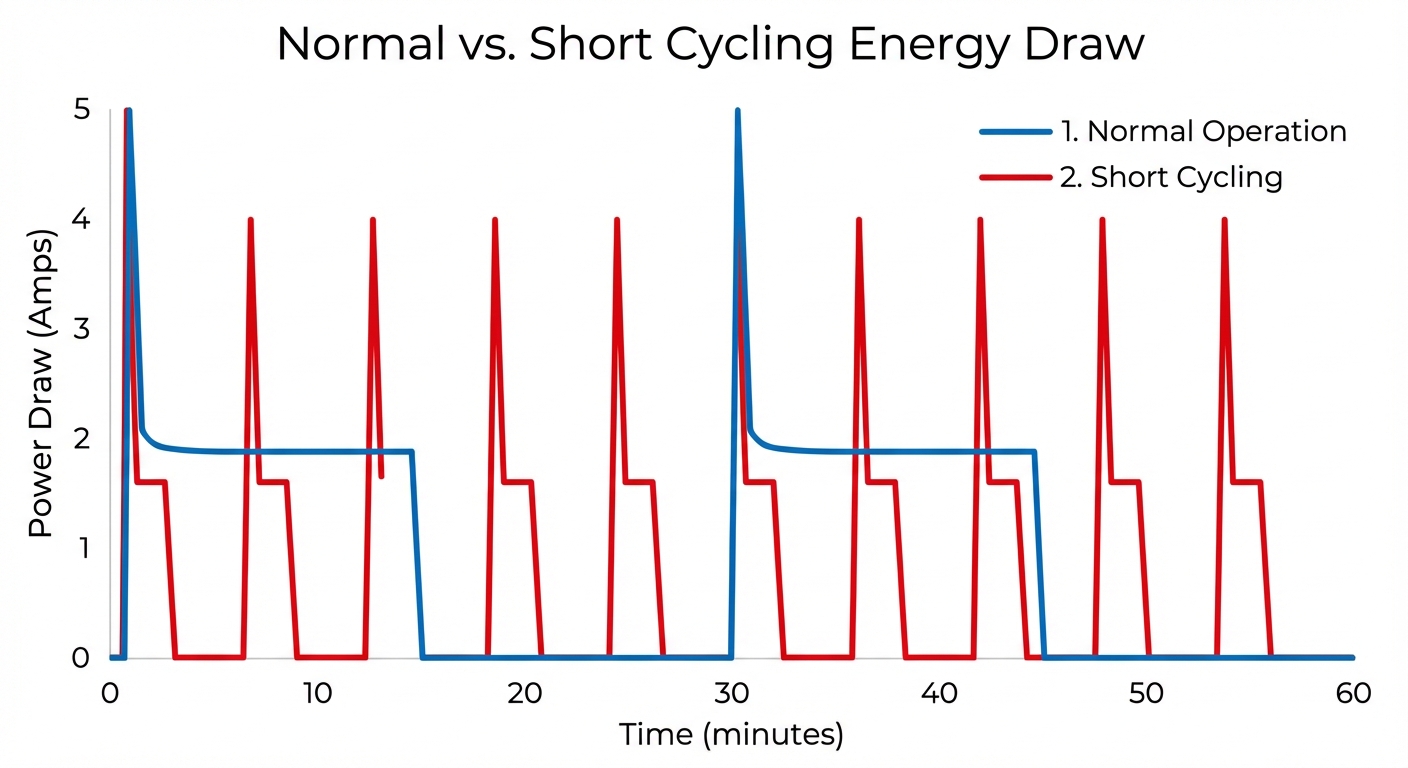
The electrical implications of this rapid cycling pattern are staggering. Compressors and blower motors require an “inrush current”—technically called Locked Rotor Amps (LRA)—that can be 3-5 times higher than normal running current during startup. Think of it like a car requiring more fuel to accelerate from a standstill than to maintain highway speed.
Every time your system starts, it experiences this massive electrical surge. When this happens 10+ times per hour instead of the normal 2-3 times, you’re accelerating wear on critical components like capacitors, contactors, and the compressor itself. It’s the equivalent of doing dozens of stop-and-go sprints instead of maintaining a steady jog—your system simply wasn’t designed to handle that kind of stress.
Beyond the mechanical damage, short cycles prevent your system from reaching thermodynamic equilibrium. Your home never quite reaches the desired temperature, and more importantly, humidity isn’t properly controlled. Air conditioners need to run for at least 10 minutes to reach the dew point and begin extracting moisture from your indoor air. Without adequate dehumidification, even a cool home can feel clammy and uncomfortable.
Diagnosing the Problem: What’s Causing Your System to Short Cycle?
Short cycling rarely occurs without reason. Understanding the most common culprits can help you identify whether you’re dealing with a simple fix or a more complex system issue.
Cause #1: Clogged Air Filters (Most Common)
The humble air filter is often the unsung hero—or villain—of HVAC performance. When filters become clogged with dust, pet dander, and debris, they restrict airflow throughout your entire system.
In heating mode, this restriction prevents cold return air from reaching the heat exchanger. Heat becomes trapped inside the furnace, causing internal temperatures to spike dangerously. When this happens, the high limit switch—a critical safety mechanism—automatically shuts the burner off to prevent a fire hazard. Once the unit cools down sufficiently, it turns back on, creating the classic short cycling pattern.
During cooling season, the consequences are equally problematic. Restricted airflow means warm indoor air can’t properly flow over the evaporator coil. The coil’s temperature drops below freezing, causing condensation to turn to ice. This ice formation creates pressure imbalances that force the system to shut down. As the ice melts, the cycle repeats.
The Department of Energy reports that simply replacing a dirty filter can lower energy consumption by 5-15%. More importantly, it’s one of the easiest preventive measures you can take.
Action Item: Check your filters monthly and replace them every 1-3 months, more frequently if you have pets or allergies. Don’t wait for them to look visibly dirty—by that point, significant restriction has already occurred.
Cause #2: Thermostat Issues
Your thermostat acts as the command center for your entire HVAC system, and its placement is far more critical than most homeowners realize. When a thermostat is improperly located, it experiences what technicians call “ghost readings”—temperature measurements that don’t reflect the actual conditions throughout your home.
Common problematic locations include:
- Walls receiving direct sunlight through nearby windows
- Areas near heat-producing appliances like ovens or televisions
- Drafty locations near exterior doors or windows
- Positions directly above or beside supply vents
When your thermostat thinks the house has reached the target temperature based on its artificially warm or cool microenvironment, it shuts the system down prematurely. The rest of your home remains uncomfortable, and the system short cycles as it struggles to satisfy an impossible-to-meet demand.
Action Item: Ensure your thermostat is installed on an interior wall, away from windows, doors, heat sources, and direct airflow from vents. If you suspect placement issues, consult with an HVAC professional about relocation.
Cause #3: System Oversizing
Here’s a counterintuitive truth that catches many homeowners off guard: bigger is not better when it comes to HVAC equipment.
For decades, contractors relied on a simplistic “Rule of Thumb” sizing method, allocating roughly 1 ton of cooling capacity per 400-500 square feet. This approach completely ignores critical variables like insulation quality, window efficiency, solar orientation, air infiltration rates, and local climate patterns.
The result? Chronically oversized systems that cool or heat spaces too quickly without running long enough to properly dehumidify or maintain consistent temperatures. An oversized unit reaches the thermostat’s setpoint in just a few minutes, shuts off, then restarts shortly after as the temperature drifts away from target.
Research from Lawrence Berkeley National Laboratory found that systems oversized by just 50% lose 9-11% in seasonal efficiency solely from cycling losses—the energy wasted during those constant startups.
Action Item: If you’re installing a new system or suspect your current one is oversized, insist on a proper ACCA Manual J load calculation. This modern methodology accounts for your home’s unique characteristics and ensures proper sizing from day one.
Cause #4: Refrigerant Issues
Your air conditioning system operates on a precise balance of refrigerant—too much or too little throws everything out of equilibrium. Low refrigerant levels, typically caused by leaks in the refrigerant lines, create a cascade of problems.
When refrigerant charge is low, the evaporator coil becomes excessively cold, causing it to freeze. This ice formation triggers the low-pressure safety switch, which shuts the system down to prevent compressor damage. Once the ice melts, the system attempts to restart, and the cycle repeats.
Unlike a clogged filter, refrigerant issues require professional intervention. Simply adding more refrigerant without identifying and sealing the leak is a temporary band-aid that wastes money and harms the environment.
Action Item: If you notice ice formation on your indoor or outdoor coils, or if your system is blowing warm air despite running, contact a licensed technician for proper leak detection and refrigerant recharging.
Cause #5: Dirty Flame Sensors (Gas Furnaces)
For homeowners with gas furnaces, a contaminated flame sensor presents another common short cycling culprit. This small but critical component monitors the burner flame to ensure safe operation.
When the sensor becomes coated with carbon deposits or other contaminants, it fails to properly detect the flame. The gas valve interprets this as a dangerous condition and automatically shuts off within seconds of ignition, creating an extreme short cycling pattern where the furnace lights, runs briefly, shuts off, and repeats.
Action Item: Annual professional maintenance includes flame sensor cleaning and inspection. If you notice your furnace lighting and immediately shutting off, this component is likely the issue.
What Short Cycling is Really Costing You (It’s More Than Your Energy Bill)
The true price of ignoring short cycling extends far beyond the immediate discomfort of inconsistent temperatures. Let’s break down the multifaceted costs that accumulate over time.
Financial Impact
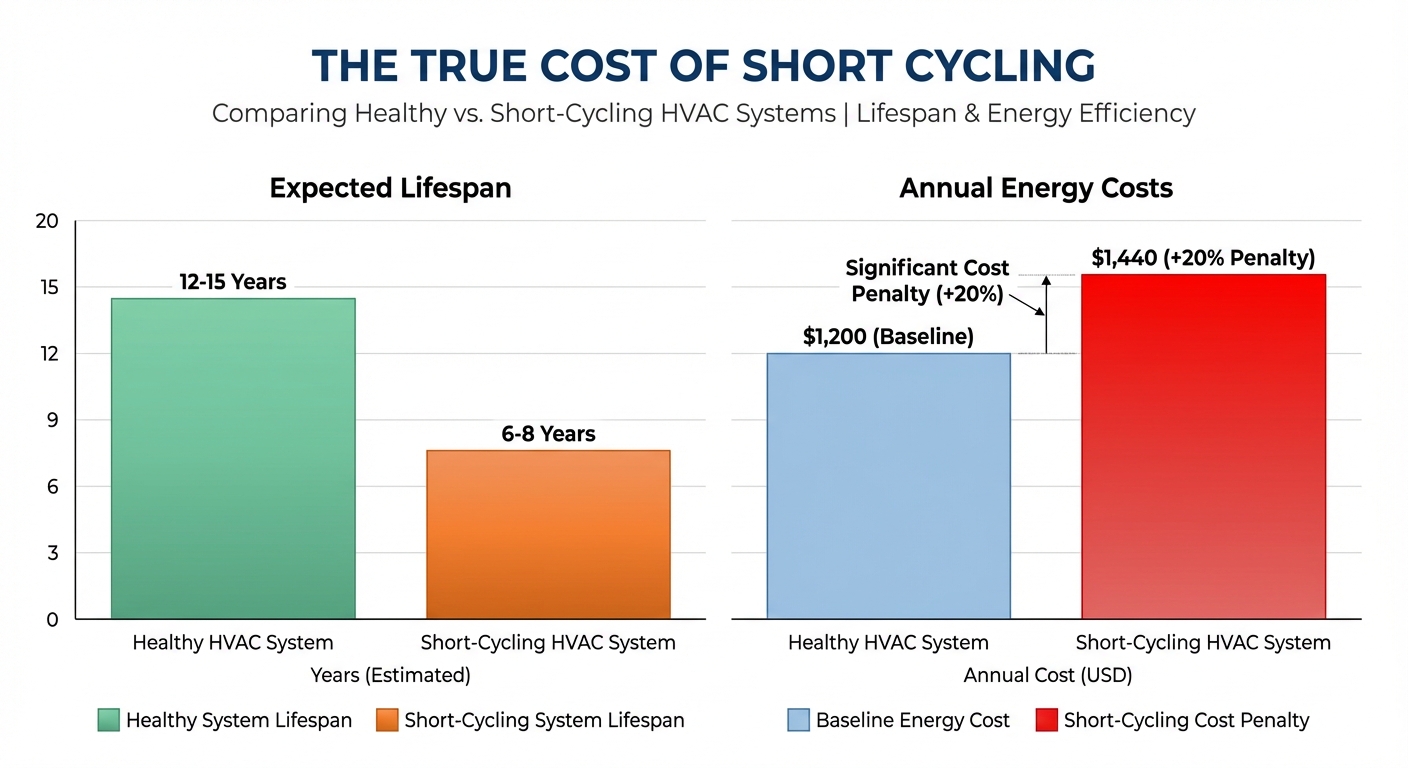
Short cycling can increase your annual energy costs by up to 20% according to EPA estimates. Those constant electrical surges during startup consume vastly more power than steady-state operation. Over a typical 10-year period, this translates to thousands of dollars in unnecessary utility expenses.
Beyond energy waste, the mechanical stress of rapid cycling dramatically shortens equipment lifespan. Where a properly maintained system should last 12-15 years, a short-cycling unit often fails in just 6-8 years. That means facing a $5,000-$10,000 replacement bill nearly twice as quickly as you should.
When you factor in both increased operating costs and premature replacement, a homeowner dealing with chronic short cycling could easily spend $10,000 or more in avoidable expenses over a decade.
Comfort and Air Quality
The comfort issues created by short cycling go beyond simple temperature fluctuations. Because air conditioners must run for at least 10 minutes to effectively extract moisture from indoor air, short cycling systems fail miserably at dehumidification.
The EPA warns that indoor humidity levels above 50% promote mold growth, dust mite proliferation, and can significantly exacerbate asthma and allergy symptoms. In the Pacific Northwest’s already humid climate, this becomes especially problematic.
You’ll notice cold spots and warm pockets throughout your home as the system fails to properly circulate and condition air. Rooms farther from the thermostat suffer the most, creating an uncomfortable, inconsistent indoor environment despite your system technically “working.”
Equipment Stress
The mechanical toll of short cycling manifests in multiple ways. Heat exchangers experience thermal fatigue from rapid temperature cycling—repeatedly expanding and contracting stresses metal components far beyond their design parameters.
Compressors, the heart of your cooling system, wear down exponentially faster under constant start-stop conditions. Contactors and relays suffer from electrical arcing each time they engage and disengage. Capacitors, which provide the electrical boost needed for startup, degrade more rapidly when repeatedly stressed.
Research from Pacific Northwest National Laboratory demonstrated that restricted airflow conditions (which often cause short cycling) degraded heat pump performance by over 15%, forcing the equipment to work harder to achieve the same results.
Real-World Example
Consider a Vancouver homeowner with an oversized 3-ton AC unit when 2 tons would have sufficed. Over a 10-year period:
- They pay approximately $2,000 more in unnecessary electricity costs
- Experience chronic humidity issues requiring supplemental dehumidification
- Face compressor failure around year 7 instead of year 12-15
- Ultimately spend over $10,000 in avoidable expenses
This scenario plays out in homes across the Pacific Northwest every day, costing families money and comfort.
Why “Bigger is Better” is Actually Destroying Your HVAC System
Perhaps no misconception causes more HVAC problems than the belief that larger capacity equals better performance. Understanding why this is false requires examining both outdated practices and modern standards.
The Old Way (Rule of Thumb)
For decades, the HVAC industry relied on simplified sizing calculations—the infamous “Rule of Thumb” approach. Contractors would allocate roughly 1 ton of cooling capacity for every 400-500 square feet of living space, with similar simple calculations for heating capacity.
This method’s fatal flaw? It ignores virtually every factor that actually determines your home’s heating and cooling needs:
- Insulation quality and R-values
- Window efficiency and solar heat gain
- Ceiling heights and building orientation
- Air infiltration rates and ductwork design
- Local climate patterns and temperature extremes
The predictable result was chronically oversized systems that delivered poor performance despite their raw capacity. These oversized units cooled or heated quickly on extreme weather days but short cycled relentlessly during the mild weather that characterizes most of the year in the Pacific Northwest.
The Modern Standard (ACCA Manual J)
Today’s industry gold standard is the ACCA Manual J load calculation—a comprehensive, scientifically rigorous methodology that accounts for your home’s actual thermal characteristics.
Manual J calculations consider:
- Detailed insulation values for walls, ceilings, and floors
- Window types, sizes, orientations, and shading
- Air infiltration rates based on construction quality
- Internal heat gains from occupants and appliances
- Historical climate data specific to your location
- Ductwork design and efficiency
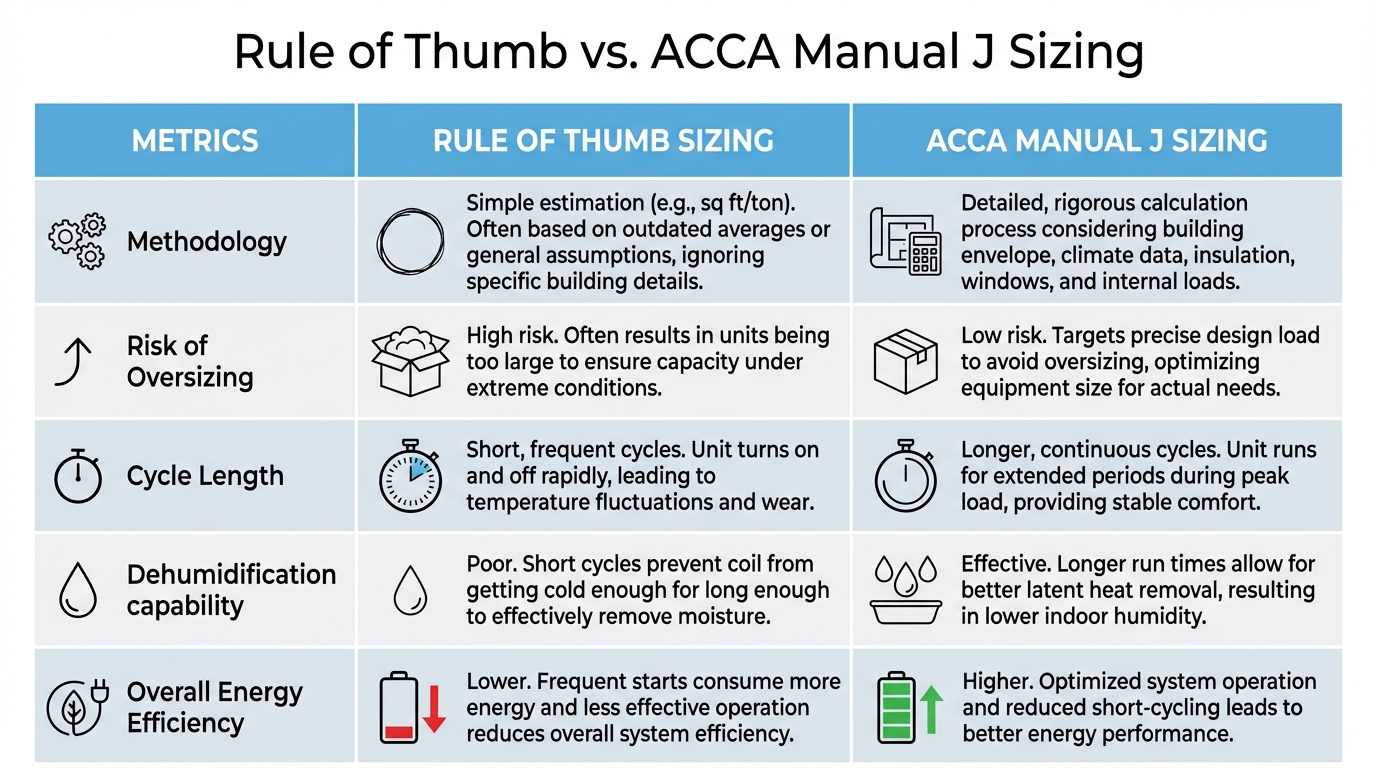
The precision of Manual J virtually eliminates oversizing, producing systems that run longer, more efficient cycles. These properly sized units extract humidity effectively, maintain consistent temperatures, and operate at peak efficiency year-round.
The Performance Difference
The operational differences between properly sized and oversized systems are dramatic:
| Properly Sized Systems | Oversized Systems |
|---|---|
| Run 10-20 minute cycles at design conditions | Run 3-5 minute cycles during mild weather |
| Extract humidity effectively throughout the cycle | Shut off before effective dehumidification occurs |
| Operate primarily at steady-state efficiency | Waste enormous energy on constant startups |
| Maintain consistent temperatures throughout the home | Create temperature swings and hot/cold spots |
| Experience minimal cycling losses | Accelerate component wear through excessive cycling |
Why This Matters in the Pacific Northwest
Our regional climate makes proper sizing even more critical than in areas with extreme, consistent weather patterns. Vancouver and Portland experience moderate, variable conditions for most of the year, with only occasional temperature extremes.
Oversized systems excel on those handful of 95°F days or 25°F nights but short cycle miserably during the mild 70°F afternoons and 40°F evenings that define our actual climate. Since your system operates during mild weather far more than extreme weather, you’re effectively optimized for the wrong conditions.
The same principle applies to heating systems facing our mild winters—oversized furnaces or heat pumps rapidly overshoot target temperatures, creating uncomfortable temperature swings and wasting energy.
Fixing Short Cycling: From Quick Fixes to Long-Term Solutions
Now that you understand what causes short cycling and why it matters, let’s explore actionable solutions ranging from simple DIY maintenance to comprehensive professional interventions.
Immediate Homeowner Actions
Before calling a professional, there are several troubleshooting steps you can take yourself:
Filter inspection and replacement:
Check your air filter monthly and replace it every 1-3 months depending on conditions. Homes with pets, smokers, or allergy sufferers should replace filters more frequently. Use filters with appropriate MERV ratings (8-11 for most residential systems)—overly restrictive MERV 13+ filters can paradoxically cause airflow issues in older systems not designed for them.
Thermostat verification:
Confirm your thermostat is properly placed on an interior wall, away from heat sources, windows, and direct sunlight. Check that it’s set to the correct mode (heat or cool) and that temperature settings are appropriate. If you have an older model, gently clean the internal sensors with compressed air.
Vent and register inspection:
Walk through your home and ensure at least 80% of supply and return vents are fully open and unobstructed by furniture, curtains, or other objects. Blocked vents create the same airflow restrictions as clogged filters.
Simple observation:
Time your system’s cycles with a stopwatch or your phone. If your system consistently cycles in less than 8 minutes during moderate weather, professional diagnosis is needed regardless of whether you’ve addressed the simple issues above.
When to Call a Professional
Certain short cycling causes require specialized knowledge, tools, and licensing to address safely and effectively:
- Persistent short cycling after you’ve replaced filters and verified thermostat placement
- Visible ice formation on indoor or outdoor coils
- Unusual sounds during startup or shutdown (grinding, clicking, buzzing)
- Inconsistent heating or cooling despite the system running
- Flames that immediately shut off on gas furnaces
- Systems more than 10 years old experiencing new cycling issues
Professional Diagnostic Services
Licensed HVAC technicians have access to specialized diagnostic tools and expertise that reveal issues invisible to homeowners:
Refrigerant leak detection and recharging:
Using electronic leak detectors and pressure gauges, technicians can identify even tiny leaks in refrigerant lines, properly seal them, and recharge your system to exact factory specifications. This isn’t a DIY job—improper refrigerant handling violates EPA regulations and can damage your system.
Flame sensor cleaning or replacement:
For gas furnaces, technicians can safely access the burner assembly, clean or replace contaminated flame sensors, and verify proper ignition sequencing.
Comprehensive airflow measurement:
Professional-grade manometers and anemometers measure actual airflow rates across your system, identifying restrictions that aren’t obvious through visual inspection alone. This often reveals ductwork problems contributing to short cycling.
Load calculation verification:
For systems 10+ years old or installations performed before modern standards became widespread, a new ACCA Manual J calculation can reveal whether your current equipment is appropriately sized for your home’s actual needs.
Long-Term Solutions
When simple maintenance and repairs aren’t sufficient, more comprehensive solutions may be warranted:
For oversized systems:
Variable-speed or inverter-driven compressors represent the cutting edge of HVAC technology. Unlike traditional single-stage compressors that operate at 100% capacity or turn off completely, variable-speed systems can modulate output down to 20-30% of maximum capacity. This eliminates short cycling by allowing the system to run continuously at ultra-low, ultra-efficient power levels during mild weather.
For aging systems:
If your system is approaching the end of its expected lifespan and experiencing chronic short cycling, replacement with properly sized equipment using ACCA Manual J calculations makes more financial sense than continued repairs. Modern equipment offers dramatically better efficiency, often paying for itself through reduced energy costs over its lifetime.
Preventive maintenance programs:
Annual professional tune-ups catch developing issues before they cause short cycling. During these visits, technicians clean coils, check refrigerant levels, test electrical components, measure airflow, and verify safe operation—all of which prevent the conditions that lead to cycling problems. Consider Sarkinen’s maintenance membership program starting at just $29.99/month for priority service and exclusive discounts.
Why Professional Diagnosis Matters
While homeowners can address obvious issues like dirty filters, diagnosing complex causes requires specialized training and equipment. Misdiagnosis leads to unnecessary repairs—or worse, missed underlying problems that continue damaging your system.
A refrigerant issue might look like a thermostat problem to an untrained eye. An oversizing issue might be misattributed to a dirty filter. Professional technicians use systematic diagnostic procedures to identify root causes rather than just treating symptoms.
Final Thoughts
Short cycling isn’t just an annoyance—it’s a serious mechanical problem that costs Pacific Northwest homeowners thousands of dollars in wasted energy and premature equipment failure. Whether caused by something as simple as a clogged air filter or as complex as improper system sizing, the consequences are always the same: reduced comfort, inflated utility bills, and accelerated equipment wear.
The good news? Most short cycling issues are completely preventable and fixable. By understanding the warning signs, performing basic maintenance like regular filter changes, and partnering with qualified HVAC professionals for proper diagnostics and sizing, you can ensure your system operates efficiently for its full expected lifespan.
If you’ve noticed your heating or cooling system cycling on and off more frequently than normal, don’t wait for a complete breakdown. The longer short cycling continues, the more damage accumulates—and the more expensive the eventual repair becomes.
Is Your HVAC System Short Cycling?
Don’t let a preventable problem cost you thousands in energy bills and premature replacement. Our expert technicians can diagnose and resolve short cycling issues quickly and effectively.
For Vancouver, WA, and Portland, OR homeowners experiencing short cycling issues, Sarkinen Heating & Cooling offers comprehensive diagnostics, expert repairs, and proper ACCA Manual J load calculations for new installations. Contact us today to schedule an evaluation and protect your HVAC investment.
References:
- U.S. Department of Energy (DOE). (2024). Central Air Conditioning. Office of Energy Efficiency & Renewable Energy. https://www.energy.gov/energysaver/central-air-conditioning
- National Renewable Energy Laboratory (NREL). (2013). Measured Performance of Residential Air Conditioners. https://www.nrel.gov/docs/fy13osti/56381.pdf
- U.S. Department of Energy (DOE). (2023). Maintaining Your Air Conditioner. Office of Energy Efficiency & Renewable Energy. https://www.energy.gov/energysaver/maintaining-your-air-conditioner
- ENERGY STAR / U.S. Environmental Protection Agency (EPA). (2024). Proper Use Guidelines for Programmable Thermostats. https://www.energystar.gov/products/heating_cooling/programmable_thermostats/proper_use_guidelines
- Pacific Northwest National Laboratory (PNNL). (2020). Impacts of Commercial Building Controls on Energy Savings and Peak Load Reduction. https://www.pnnl.gov/main/publications/external/technical_reports/PNNL-25985.pdf
- Air Conditioning Contractors of America (ACCA). (2024). Manual J Residential Load Calculation. https://www.acca.org/standards/manual-j
- ENERGY STAR / U.S. Environmental Protection Agency (EPA). (2024). Heating and Cooling Maintenance Checklist. https://www.energystar.gov/campaign/heating_cooling/maintenance_checklist
- Lawrence Berkeley National Laboratory (LBNL). (2014). Energy and Economic Impacts of AC Oversizing. https://eta.lbl.gov/publications/energy-economic-impacts-ac-oversizing