
Table of Contents
- The Perfect Storm: Why Pacific Northwest Winters Make Your Heat Pump Frost
- The Science Behind the Steam: How Your Heat Pump Melts Ice
- Not All Defrost Systems Are Created Equal: Time-Temperature vs. Demand-Defrost
- How to Tell if It’s Normal Defrost or a Mechanical Problem
- How to Prevent Defrost Problems Before They Start
- Final Thoughts
It’s a cold, drizzly January morning in Vancouver. You’re sipping your coffee, glancing out the kitchen window, when you notice thick white plumes billowing from your outdoor heat pump. Your heart skips a beat. Is my house about to catch fire? Take a deep breath. In 95% of cases, that alarming “smoke” is actually harmless steam from your heat pump’s defrost cycle—a completely normal and essential function of the system. At Sarkinen Heating & Cooling, we receive dozens of panicked calls every winter from homeowners convinced their heat pump is on fire, only to discover their system is simply doing exactly what it was designed to do. Here’s what makes our Pacific Northwest climate particularly prone to this phenomenon: our wet, mild winters with temperatures hovering around 35-40°F and humidity levels exceeding 80% create the perfect conditions for heat pump frosting. It’s not a flaw in your system—it’s physics responding to our unique weather patterns. In this comprehensive guide, you’ll learn the science behind why your heat pump frosts up, how the defrost cycle works, how to distinguish normal operation from a genuine problem, and when it’s time to call in the professionals at Sarkinen Heating & Cooling.
The Perfect Storm: Why Pacific Northwest Winters Make Your Heat Pump Frost
Our region’s climate is uniquely positioned to challenge heat pumps. While homeowners in frigid Montana might assume colder weather means more frost, the opposite is actually true. Understanding why requires a closer look at the relationship between temperature and humidity. During typical Vancouver and Portland winters, morning temperatures settle between 34-38°F while relative humidity regularly exceeds 80%. This combination represents the exact sweet spot for maximum frost accumulation on heat pump coils. The outdoor coil’s surface temperature drops below both the dew point and freezing point simultaneously, causing moisture in the air to freeze directly onto the metal fins and refrigerant tubing. Here’s the counterintuitive part: extreme cold actually produces less frost. When temperatures plunge to 10°F in places like Denver or Minneapolis, the air becomes so dry it holds very little moisture. Think of it this way—a 36°F drizzly Portland morning creates significantly MORE frost than a 15°F bone-dry Colorado cold snap. The moisture content of the air matters just as much as the temperature.
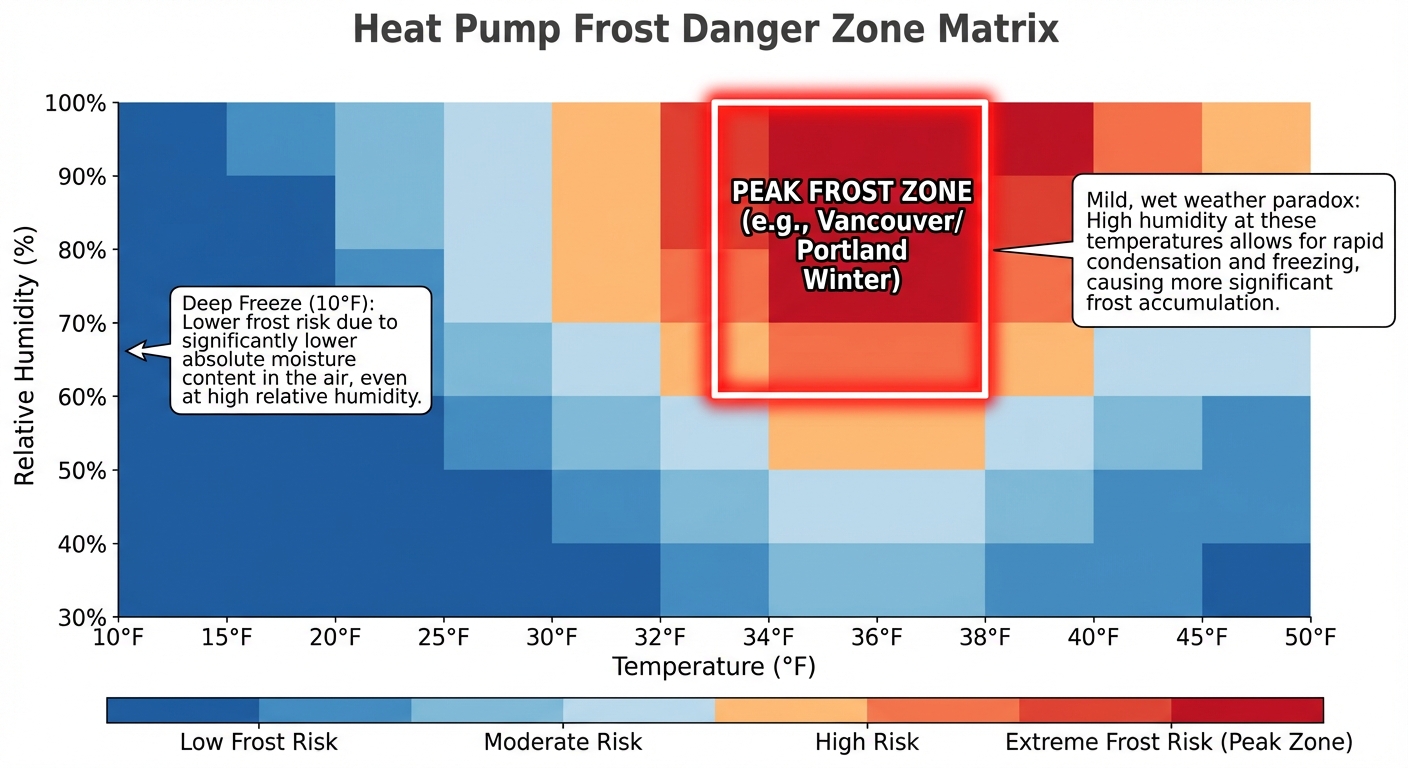
When frost accumulates on your outdoor coil, it acts as an insulator, creating a barrier between the refrigerant inside the coil and the outdoor air from which it’s trying to extract heat. Additionally, the ice blocks airflow through the coil fins, further restricting the system’s ability to function efficiently. If left unchecked, frost can degrade your heat pump’s heating capacity by up to 40%. The good news? Heat pump manufacturers understand these conditions perfectly. Modern systems are specifically designed with automatic defrost mechanisms to handle wet, moderately cold climates like ours. Your “smoking” heat pump isn’t malfunctioning—it’s intelligently managing the environmental challenges our region throws at it.
The Science Behind the Steam: How Your Heat Pump Melts Ice (And Why It Looks Like Smoke)
To appreciate why your heat pump appears to smoke during defrost, you need to understand the thermodynamic reversal happening inside the system. It’s actually quite elegant engineering. During normal heating operation, your heat pump extracts heat from the outdoor air and transfers it indoors. But when sensors detect that frost buildup has begun to degrade performance beyond a certain threshold, the system initiates its defrost cycle by temporarily becoming an air conditioner—pointed outward.
Here’s what happens during those dramatic few minutes:
The reversing valve inside your heat pump shifts position, changing the direction of refrigerant flow. Instead of routing hot refrigerant gas to the indoor coil (to heat your home), it redirects that 120-150°F hot gas directly to the outdoor coil. Simultaneously, the outdoor fan shuts off completely. This traps the heat against the icy coil, accelerating the melting process. Inside your home, auxiliary or backup heat automatically kicks in so you don’t feel cold air blowing from the vents. You might notice slightly reduced airflow for a few minutes, or the air might feel warmer than usual as the backup heat elements work. Then, once the outdoor coil is clear, everything returns to normal heating mode seamlessly.
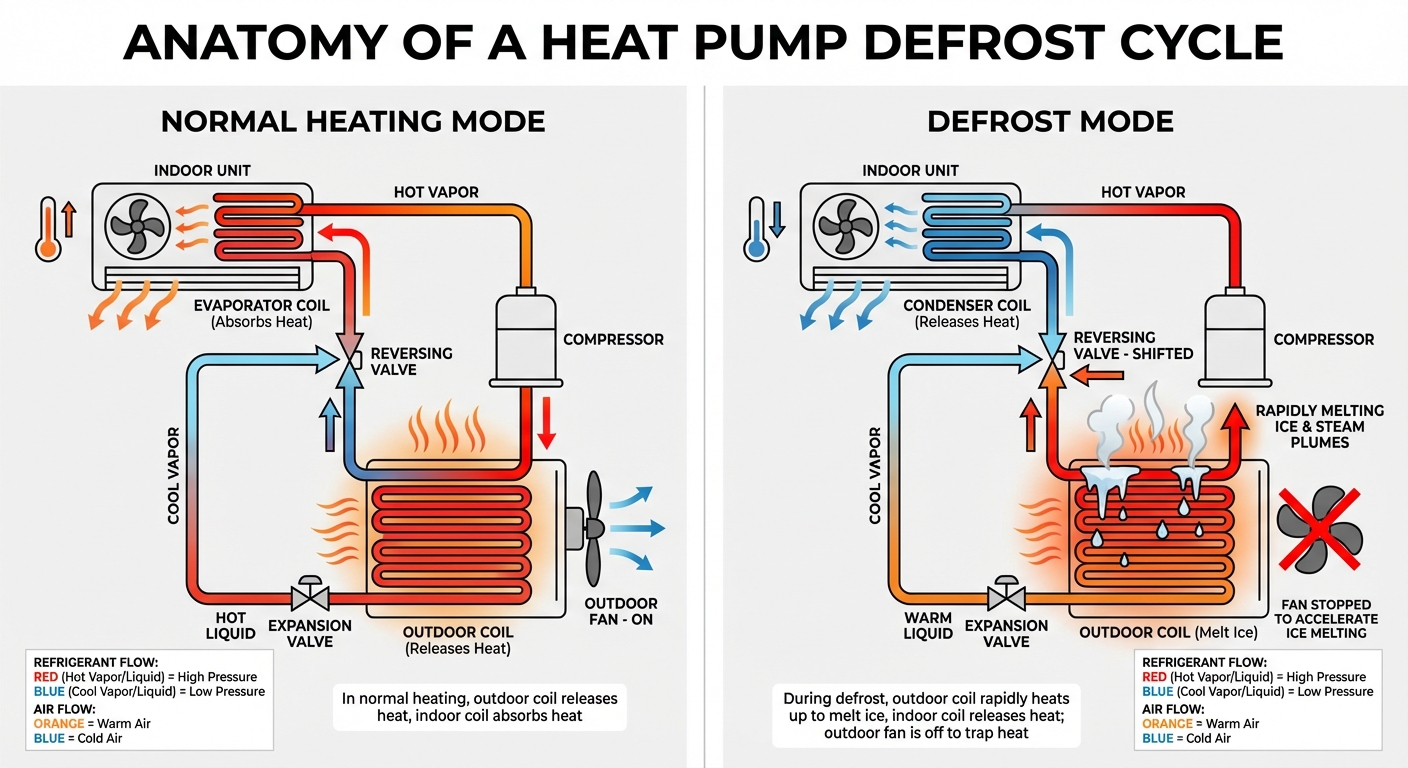
Now for the “smoking gun” explanation: As that extremely hot refrigerant rapidly melts the accumulated ice, water instantly converts to steam. When this warm water vapor hits our 35°F Pacific Northwest air, it condenses into thick, white vapor clouds. Because the outdoor fan is switched OFF during defrost, the steam can’t be dispersed. Instead, it rises in dramatic vertical plumes that look exactly like smoke. It’s the same physics that creates the visible “cloud” when you exhale on a cold morning, just on a much larger scale. The effect is amplified on particularly humid days when the condensation is even more pronounced. A normal defrost cycle lasts 5-15 minutes from start to finish. You’ll typically hear a brief “whoosh” sound as the reversing valve switches, then watch the steam show, and finally hear the system return to its normal compressor hum and outdoor fan operation. Inside, heating resumes without any noticeable interruption to your comfort.
Not All Defrost Systems Are Created Equal: Time-Temperature vs. Demand-Defrost
If you’re shopping for a new heat pump or wondering why your neighbor’s unit seems to defrost less frequently than yours, the answer likely lies in the sophistication of the defrost control system.
Legacy Time-Temperature Systems
Older heat pumps and entry-level models rely on what’s called “time-temperature defrost.” These systems operate on a rigid schedule, initiating a defrost cycle every 30, 60, or 90 minutes of compressor runtime—if a temperature sensor detects that the outdoor coil has dropped below 32°F. The problem with this approach is lack of intelligence. The system asks two simple questions: “Has it been X minutes since the last defrost?” and “Is the coil sensor reading below freezing?” If both answers are yes, it triggers defrost—even if there’s no actual frost present. This creates what the industry calls “nuisance defrosts,” wasting energy by unnecessarily reversing the system and activating expensive backup heat. Studies show that time-temperature systems can reduce seasonal heating efficiency by up to 10% due to this excessive cycling.
Modern Demand-Defrost Technology
High-efficiency and cold-climate heat pumps have evolved significantly. Today’s premium systems use sophisticated algorithms that monitor multiple variables simultaneously: ambient outdoor temperature, coil temperature, and refrigerant pressures throughout the system. By analyzing these data points together, the control board can detect actual heat transfer degradation—the signature of real frost buildup—rather than simply guessing based on time and temperature alone. These demand-defrost systems only initiate the cycle when actually needed, not on a timer. The advantage is substantial: improving winter operating efficiency by 5-8% compared to time-temperature systems. Fewer unnecessary defrost cycles mean lower utility bills, less wear on system components, and fewer “steam shows” to alarm homeowners. For Vancouver and Portland residents, this technology makes particular sense. Given our climate’s propensity for frost conditions, a cold-climate heat pump with demand-defrost capability represents a smart long-term investment. You’ll experience fewer interruptions, better comfort, and meaningfully lower heating costs throughout our wet winter months.
How to Tell if It’s Normal Defrost or a Mechanical Problem (And When to Pick Up the Phone)
Most heat pumps producing steam are operating perfectly normally. However, there are warning signs that indicate a genuine mechanical failure requiring professional diagnosis and repair. Knowing the difference can save you from an unnecessary service call—or prevent expensive damage from waiting too long when there’s a real problem.
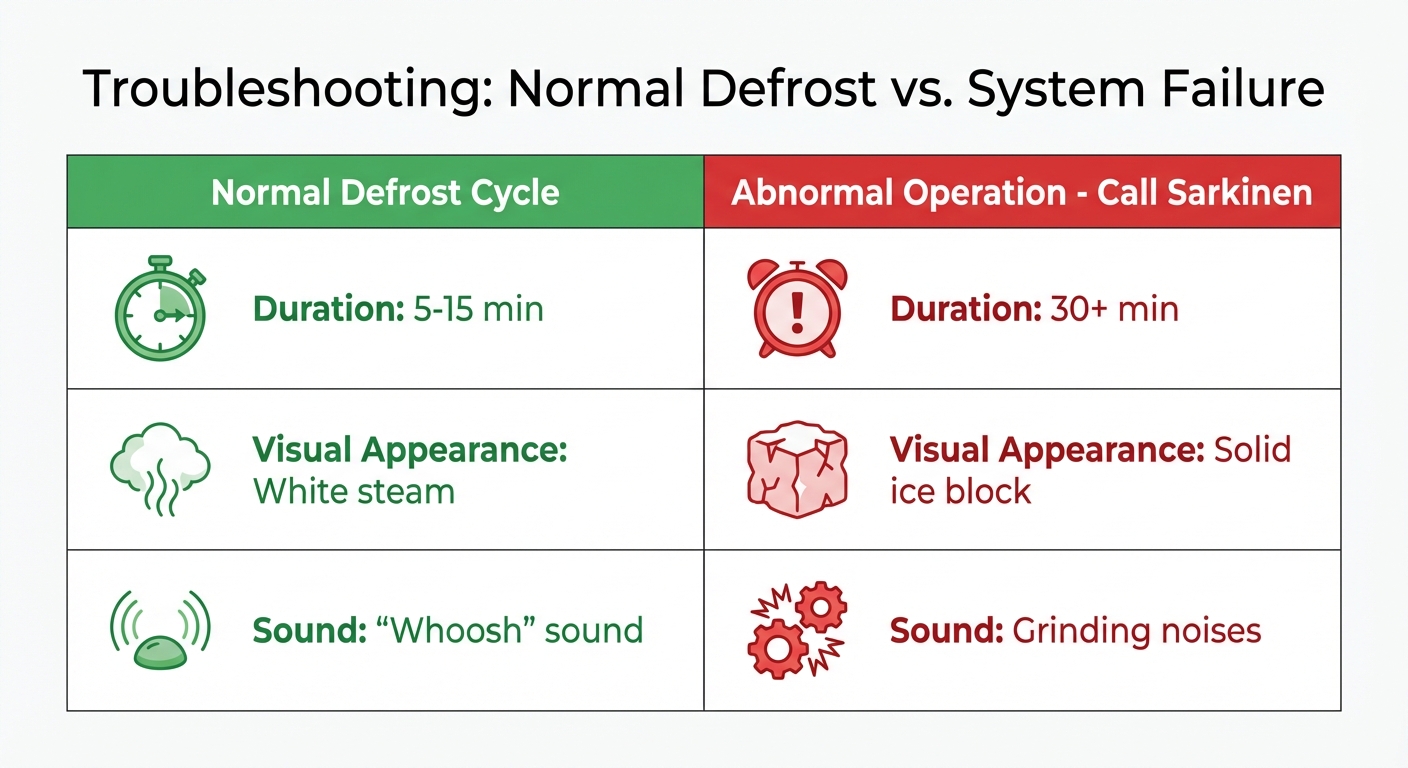
Here’s your diagnostic framework:
When It’s Normal Defrost (No Worries)
- Duration: The steam show lasts 5-15 minutes, then clears completely. The outdoor unit returns to normal operation with the fan running and no visible vapor.
- Visual Appearance: You see white vapor rising upward from the unit. The steam dissipates into the air. Within a quarter-hour, the outdoor coil looks clear and normal.
- Sound: You hear a brief “whoosh” when the reversing valve shifts, followed by normal compressor humming. The outdoor fan is silent during defrost, then resumes its typical operation.
- Indoor Comfort: Your home stays warm throughout. You might notice a slight change in airflow for a few minutes, but there’s no extended period of cold air blowing from vents.
When to Call Sarkinen Heating & Cooling
- Duration: Steam or ice persists for 30+ minutes without improvement. The unit appears “stuck” in a frosted state.
- Visual Appearance: Instead of white vapor, you see dark smoke. Or the entire outdoor unit is encased in a solid block of ice that isn’t melting. Ice may be forming faster than the system can eliminate it.
- Sound: You hear grinding, screeching, or the unmistakable sound of fan blades striking ice. These mechanical sounds indicate physical obstruction or component failure.
- Indoor Comfort: Cold air blows from your vents for extended periods. The system can’t maintain your set temperature. You may see an “auxiliary heat” or “emergency heat” indicator constantly illuminated on your thermostat.
Common Failure Modes Requiring Service
When defrost systems malfunction, four scenarios are most common:
What to Do If You Suspect a Problem
- Step 1: Wait 15 minutes. Set a timer. If it’s normal defrost, the steam will clear and the unit will resume regular operation within this timeframe.
- Step 2: If ice remains, the unit is making grinding noises, or cold air continues blowing indoors after 15 minutes, go to your thermostat and switch it to “Emergency Heat” mode. This bypasses the outdoor unit entirely and prevents further damage.
- Step 3: Call Sarkinen Heating & Cooling at (360) 940-0305. Our technicians are specifically trained in heat pump diagnostics and can quickly identify whether you’re dealing with a refrigerant issue, sensor failure, reversing valve problem, or airflow obstruction.
A real-world perspective: Oak Ridge National Laboratory conducted multi-year field studies on cold-climate heat pumps and found that homeowner panic about defrost steam was the single most common reason for unnecessary service calls. The overwhelming majority of “smoking” heat pumps were functioning exactly as designed. However, when there is a legitimate mechanical failure—particularly a stuck reversing valve or low refrigerant charge—waiting too long can allow ice accumulation to crush the outdoor coil or shear fan blades. Both scenarios result in expensive repairs that could have been avoided with timely professional intervention.
How to Prevent Defrost Problems Before They Start
The best approach to defrost anxiety is prevention. Proactive maintenance before winter arrives keeps your heat pump operating efficiently and reduces the likelihood of mechanical failures during the coldest, wettest months.
Fall Tune-Ups Are Critical
Before the first frost of the season, professional maintenance provides several key benefits:
- Sensor Calibration: Technicians verify that temperature sensors and pressure switches are accurately reading system conditions. Even minor sensor drift can cause the defrost cycle to trigger too early or too late.
- Reversing Valve Testing: The valve that enables defrost mode should be cycled and inspected for smooth operation. A valve that’s beginning to stick can be addressed before it fails completely during a cold snap.
- Refrigerant Charge Verification: Proper refrigerant levels are essential for efficient defrost operation. Professional technicians use calibrated gauges to ensure your system is charged to manufacturer specifications.
- Coil Cleaning: A clean outdoor coil improves airflow and heat transfer efficiency. This means your heat pump can extract heat more effectively, reducing how frequently frost forms in the first place.
Homeowner Maintenance You Can Do
Between professional service visits, homeowners can take several simple steps to support reliable heat pump operation:
- Keep the Outdoor Unit Clear: Regularly remove fallen leaves, landscaping debris, and snow accumulation from around the unit. Maintain at least 24 inches of clearance on all sides.
- Don’t Block Airflow: Avoid placing storage items, firewood, or seasonal decorations near the outdoor unit. Ensure bushes and shrubs are trimmed back so they don’t impede air circulation.
- Ensure Proper Drainage: Check that melted ice can drain away from the unit’s base. If water pools and refreezes underneath, it can create an “ice platform” that affects system operation and longevity.
- Monitor Performance: Get familiar with your heat pump’s normal sounds and defrost frequency. If you notice changes—defrost cycles becoming dramatically more frequent or the unit running continuously without reaching your set temperature—it’s time for professional assessment.
Why Professional Calibration Matters
While homeowners can handle basic cleanliness and clearance, the sophisticated diagnostics required for heat pump optimization require professional equipment and expertise. DIY maintenance simply can’t detect subtle refrigerant leaks, sensor drift, or the early warning signs of control board degradation. A properly maintained heat pump defrosting efficiently can save 5-10% on winter heating costs compared to a system with calibration issues or mechanical problems. Over the course of a heating season, that efficiency improvement translates to real money back in your pocket—often more than offsetting the cost of the maintenance visit itself. Sarkinen Heating & Cooling offers comprehensive preventative maintenance programs designed specifically for Pacific Northwest heat pump systems. Our technicians understand the unique challenges our wet, moderate climate presents and can ensure your system is properly calibrated before winter weather arrives. Schedule your fall inspection by calling (360) 940-0305 or visiting our contact page. A small investment in preventative care delivers peace of mind throughout the heating season—and helps ensure that when you see steam rising from your outdoor unit, you’ll know it’s just your heat pump doing its job perfectly.
Final Thoughts
That alarming “smoke” billowing from your heat pump on a cold Vancouver morning is almost certainly just steam from your system’s normal defrost cycle. It’s not a fire, not a malfunction, and not cause for panic—it’s thermodynamic engineering at work, designed specifically to handle the wet, moderately cold winters that define our Pacific Northwest climate. Our region’s unique combination of 35-40°F temperatures and 80%+ humidity creates ideal conditions for frost formation on heat pump coils. Modern systems are engineered to detect this frost buildup and automatically initiate defrost cycles that temporarily reverse refrigerant flow, melting accumulated ice within 5-15 minutes. The dramatic white plumes you see are simply water vapor condensing in the cold air. You’re now equipped to distinguish normal operation from the warning signs of genuine mechanical problems. If steam clears within 15 minutes and your home stays warm, your heat pump is functioning exactly as designed. If ice persists beyond 30 minutes, you hear grinding noises, or cold air blows indoors continuously, switch to Emergency Heat mode and contact Sarkinen Heating & Cooling. When in doubt, remember: your heat pump is a marvel of thermodynamic engineering, specifically designed for climates like ours. Understanding how it operates helps you get maximum efficiency, comfort, and peace of mind from your investment in clean, efficient heating technology.
Need Expert Heat Pump Service?
Have questions about your heat pump’s performance? Schedule a maintenance check with Sarkinen Heating & Cooling to ensure your system is winter-ready.
References:
- National Weather Service (NWS). (2024). Portland/Vancouver Climate Data and Historical Weather Normals. https://www.weather.gov/pqr/climate
- National Renewable Energy Laboratory (NREL). (2011). Air-Source Heat Pumps in Cold Climates. https://www.nrel.gov/docs/fy11osti/51119.pdf
- U.S. Department of Energy (DOE). (2023). Operating and Maintaining Your Heat Pump. https://www.energy.gov/energysaver/heat-pump-systems
- American Society of Heating, Refrigerating and Air-Conditioning Engineers (ASHRAE). (2022). Technical Resources: Managing Defrost in Cold Climate ASHPs. https://www.ashrae.org/technical-resources
- Building America / U.S. Department of Energy. (2014). Heat Pump Defrost Strategies: Demand vs. Time-Temperature. https://www1.eere.energy.gov/buildings/publications/pdfs/building_america/heat_pump_defrost.pdf
- Air Conditioning Contractors of America (ACCA). (2023). Residential Maintenance Standards & Diagnostics. https://www.acca.org/standards/quality
- Oak Ridge National Laboratory (ORNL) via U.S. Department of Energy Office of Scientific and Technical Information (OSTI). (2014). Field Performance of Inverter-Driven Heat Pumps in Cold Climates. https://www.osti.gov/biblio/1162235