
Table of Contents
- How Your HVAC System is Supposed to Work (And Why Airflow Matters)
- Reason #1: Your Air Filter is Clogged (The Most Common Culprit)
- Reason #2: Hidden Ductwork Problems Are Stealing Your Air
- Reason #3: Years of Dust and Debris Are Choking Your Ducts
- Reason #4: Your Blower Motor is Struggling (Or Failing)
- What You Can Check Yourself (And When to Call the Pros)
- Key Takeaways
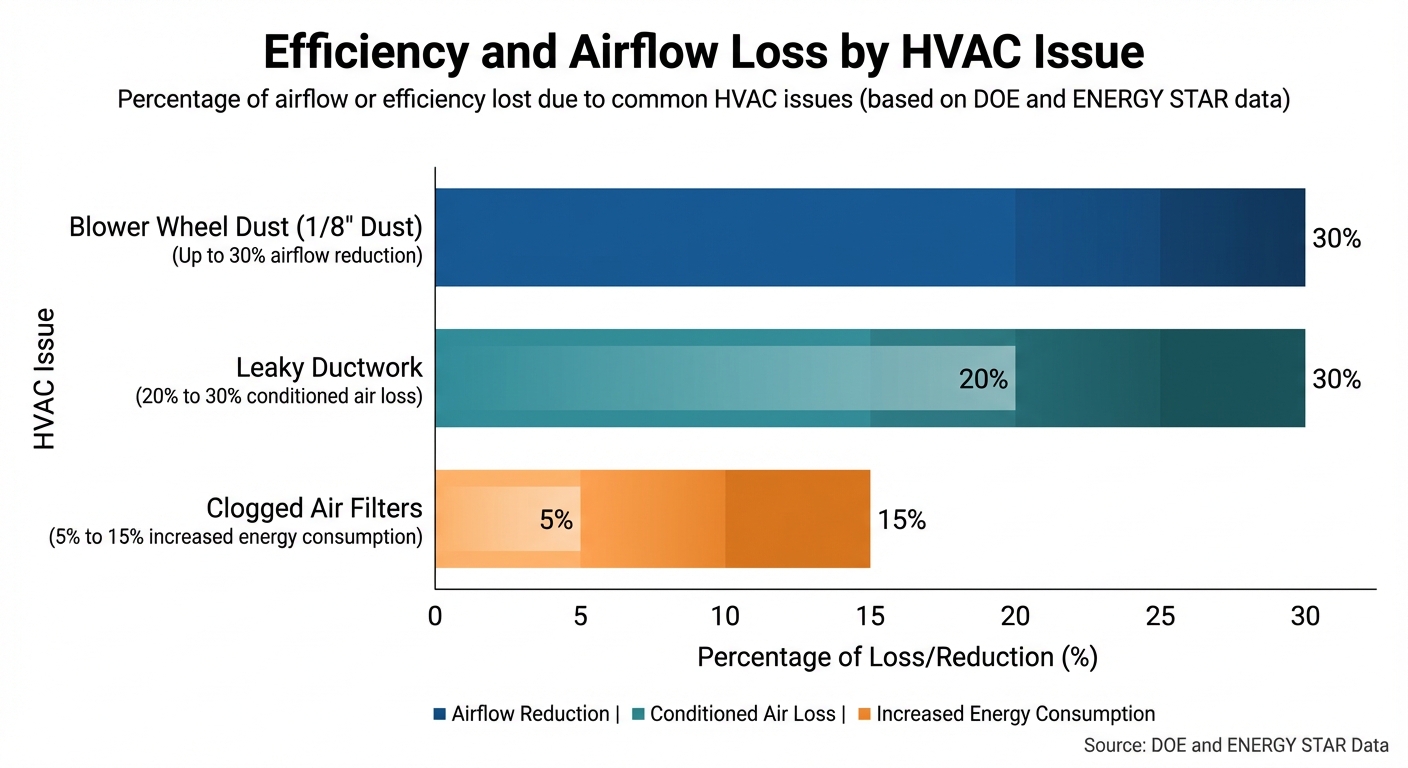
Is your bedroom always too hot in summer or freezing in winter, while other rooms feel fine? You’re not alone. Weak airflow from vents is one of the most common HVAC complaints among homeowners in Vancouver, WA, and Portland, OR—and it’s more than just a comfort issue. According to ENERGY STAR, about 20% to 30% of air moving through typical residential duct systems is lost due to leaks, holes, and poorly connected ducts. When airflow is restricted, your HVAC system works harder to compensate, driving up energy bills and shortening equipment lifespan. That bedroom that never quite reaches the right temperature? It’s likely costing you money every month. The good news is that weak vent airflow is usually fixable once you identify the root cause. In this guide, we’ll walk you through the four most common reasons your vents aren’t delivering enough air—and explain both DIY checks you can perform yourself and professional solutions that deliver lasting results. At Sarkinen Heating & Cooling, we specialize in duct diagnostics, cleaning, and repair for the unique climate challenges of the Pacific Northwest. From the high humidity of Vancouver winters to the pollen-heavy springs of the Willamette Valley, we understand what makes your HVAC system struggle—and how to fix it.
How Your HVAC System is Supposed to Work (And Why Airflow Matters)
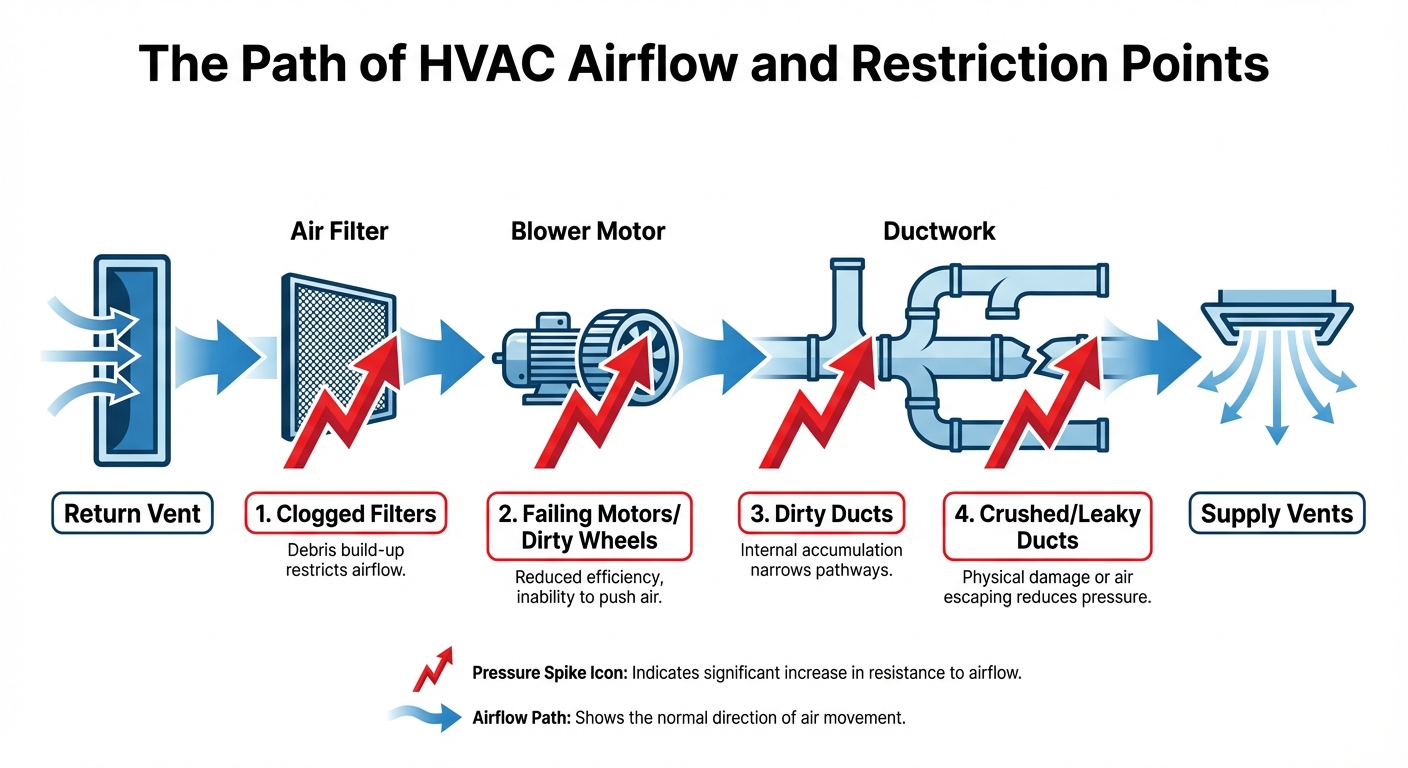
Before we dive into what goes wrong, it helps to understand how your HVAC system is designed to work. Your furnace or air conditioner isn’t just heating or cooling air randomly—it’s engineered to deliver a specific volume of air, measured in Cubic Feet per Minute (CFM), to each room in your home. Think of your HVAC system as having a circulatory system, much like your body. Air is pulled in through return vents, passes through a filter, gets heated or cooled, and is then pushed through ductwork by a blower motor before exiting through supply vents in each room. The key to this entire process is something called static pressure—the resistance to airflow within your duct system. When components fail, become dirty, or get damaged, static pressure increases. As resistance goes up, the volume of air your system can push out goes down. The consequences of increased static pressure are significant:
- Your blower motor has to work harder, consuming more energy and wearing out faster
- Hot or cold spots develop throughout your home as certain rooms receive inadequate airflow
- Strain on your system leads to breakdowns and expensive repairs
The U.S. Department of Energy notes that simply replacing a dirty, clogged filter can lower your air conditioner’s energy consumption by 5% to 15%. That single maintenance task demonstrates just how sensitive your HVAC system is to airflow restrictions. Understanding this fundamental relationship between airflow, static pressure, and system performance sets the stage for recognizing why weak airflow isn’t just uncomfortable—it’s a warning sign that something in your system needs attention before it causes bigger problems.
Reason #1: Your Air Filter is Clogged (The Most Common Culprit)
Let’s start with the simplest and most frequent cause of weak airflow: a neglected air filter. If you’re experiencing reduced airflow from your vents, there’s a very good chance this is your problem. Your air filter serves a dual purpose. It protects your blower motor and evaporator coil from dust and debris, while also improving the air quality in your home. But when a filter becomes loaded with particles, it transforms from a protective barrier into a chokepoint that severely restricts airflow. The numbers tell the story. According to the U.S. Department of Energy, replacing a dirty, clogged filter with a clean one can reduce your air conditioner’s energy consumption by 5% to 15%. That’s money directly back in your pocket, not to mention the extended lifespan of your equipment.
What You Can Do Right Now:
- Check your filter monthly, especially during heating and cooling season when your system runs most frequently
- Replace standard 1-inch filters every 1 to 3 months depending on factors like pets, allergies, and system runtime
- Consider upgrading to MERV 8-11 filters for better air quality, but be aware these may require more frequent changes due to their tighter weave
- Mark your calendar or set phone reminders so filter changes become automatic
Before moving on to more complex issues, always check your filter first. It’s the quickest, cheapest fix—and surprisingly often, it’s the solution.
Reason #2: Hidden Ductwork Problems Are Stealing Your Air
If you’ve replaced your filter and airflow remains weak in certain rooms, the problem likely lies hidden inside your walls, crawlspace, or attic—in your ductwork itself. Ductwork damage comes in several forms, and each creates a different kind of airflow problem:
Crushed or Kinked Flexible Ducts
These are especially common in crawlspaces and attics. Someone stores holiday decorations in the attic and sets a box on a flexible duct run. A contractor doing electrical work steps on ductwork in a tight crawlspace. An HVAC installer takes a shortcut during original construction, creating a sharp bend that restricts flow. The result is the same: a drastically reduced cross-sectional area that chokes airflow to specific rooms.
Unsealed Joints
Where duct sections connect represent another major problem. ENERGY STAR reports that 20% to 30% of air moving through duct systems is lost due to leaks, holes, and poorly connected ducts. Imagine paying to heat or cool air that never makes it to your living spaces—instead, it’s warming your attic or cooling your crawlspace.
Disconnected Ducts
These are exactly what they sound like: sections of ductwork that have separated entirely. This might happen due to poor installation, house settling over time, or physical damage. The result is that a room receives virtually no conditioned air at all.
When to Call Sarkinen Heating & Cooling:
- Certain rooms consistently receive weak airflow despite having a clean filter
- You can see visible damage, disconnections, or gaps in accessible ductwork
- You hear air hissing from ducts in your attic or crawlspace
- Your home has never had a professional duct inspection
- Your home was built more than 20 years ago (duct sealant and connections degrade over time)
Research from Lawrence Berkeley National Laboratory demonstrates the value of professional intervention. In their field studies, sealing and cleaning ducts recovered an average of 20% of lost heating and cooling energy while significantly increasing vent velocity in distant rooms. That’s not just improved comfort—it’s lower bills and reduced wear on your equipment.
Reason #3: Years of Dust and Debris Are Choking Your Ducts
Even if your ductwork is physically intact and properly sealed, what’s accumulated inside over the years can severely restrict airflow. Think of it like cholesterol building up in arteries—gradually reducing flow until the system can’t function properly. Your ducts collect more than you might imagine over time:
- Dust and pet dander
- Construction debris from remodeling projects
- Pollen (especially heavy in the Pacific Northwest)
- In humid climates like Vancouver and Portland, even mold growth
The mechanism is straightforward: particulate buildup creates “surface roughness” inside your ducts. This increases aerodynamic friction, forcing your blower motor to work significantly harder to push air through the system. It’s the difference between trying to slide something across a smooth table versus rough sandpaper—the resistance is dramatically higher. The EPA acknowledges that while light dust is normal, heavily contaminated ducts significantly impede airflow and reduce HVAC efficiency. In the Pacific Northwest specifically, our climate compounds this issue. High humidity during winter months causes dust to clump and stick to duct walls far more stubbornly than it would in dry climates like Arizona or Nevada.
The National Air Duct Cleaners Association sets the standard for professional duct cleaning, and their guidance is clear: source removal is the only effective way to clean HVAC systems and restore proper airflow. This means using negative air machines to create suction while rotary brushes physically agitate and dislodge stuck debris. Your household vacuum, no matter how powerful, cannot replicate this process. It lacks the reach to access deep duct sections, the suction power to extract firmly adhered debris, and the agitation tools to break loose compacted material.
Signs You Need Professional Duct Cleaning:
- Visible dust or debris blowing from supply vents when the system starts
- Musty or stale odors when your furnace or AC runs
- Unexplained allergy symptoms or respiratory irritation that improve when you’re away from home
- It’s been 3 to 5 years since your last professional cleaning (or you’ve never had one done)
- You’ve completed a remodeling project that generated sawdust or drywall dust
- You’ve recently moved into a home and don’t know the duct cleaning history
Professional duct cleaning does more than restore airflow—it also improves indoor air quality and can extend the life of your HVAC equipment by reducing the dust load on critical components like the blower motor and evaporator coil.
Reason #4: Your Blower Motor is Struggling (Or Failing)
If you’ve checked your filter, your ducts appear intact, and you’ve recently had duct cleaning performed, but airflow remains weak throughout your home, the problem likely lies with the mechanical heart of your system: the blower motor. The blower motor is responsible for physically moving air through your entire duct system. When it’s struggling or beginning to fail, every vent in your house will deliver reduced airflow—unlike ductwork problems that typically affect specific rooms.
Three Primary Causes of Blower Motor Degradation:
1. Dust Accumulation on Blower Wheel Blades
This is surprisingly impactful. The U.S. Department of Energy reports that just 1/8th of an inch of dust buildup on blower wheel blades can reduce airflow capacity by up to 30%. The dust changes the aerodynamic profile of the blades, reducing their efficiency at moving air. Think of it like adding mud to a ceiling fan—it becomes unbalanced and less effective.
2. Failing Capacitors
The capacitor provides the electrical torque needed to start the motor and keep it running at the proper speed (RPM). As capacitors age and weaken, they can’t deliver adequate power. The motor still runs, but at reduced speed, producing less airflow. Eventually, a failing capacitor leads to complete motor failure.
3. Worn Belts
In older belt-driven systems, worn belts create a similar problem. As belts age, they stretch and can slip on their pulleys, preventing the blower fan from reaching optimal speed. A loose belt also creates squealing noises that homeowners often notice before they realize airflow has decreased.
Warning Signs Your Blower Motor is Failing:
- Your HVAC system cycles on normally, but very little air comes from vents throughout the house
- Unusual noises from the air handler: squealing, grinding, or humming sounds
- The system frequently trips breakers or shuts down unexpectedly
- Energy bills have increased significantly despite no change in usage patterns or weather
- The system runs constantly but never quite reaches the thermostat setting
The good news is that blower motor issues are highly preventable through annual HVAC maintenance. During a professional tune-up, technicians inspect the capacitor, check electrical connections, measure amp draw to verify the motor is running efficiently, and clean the blower wheel. Catching capacitor wear or dust buildup during routine maintenance prevents the catastrophic failure that leaves you without heating or cooling when you need it most.
What You Can Check Yourself (And When to Call the Pros)
Now that you understand the four main causes of weak airflow, let’s talk about what you can safely check yourself—and when it’s time to bring in professional expertise.
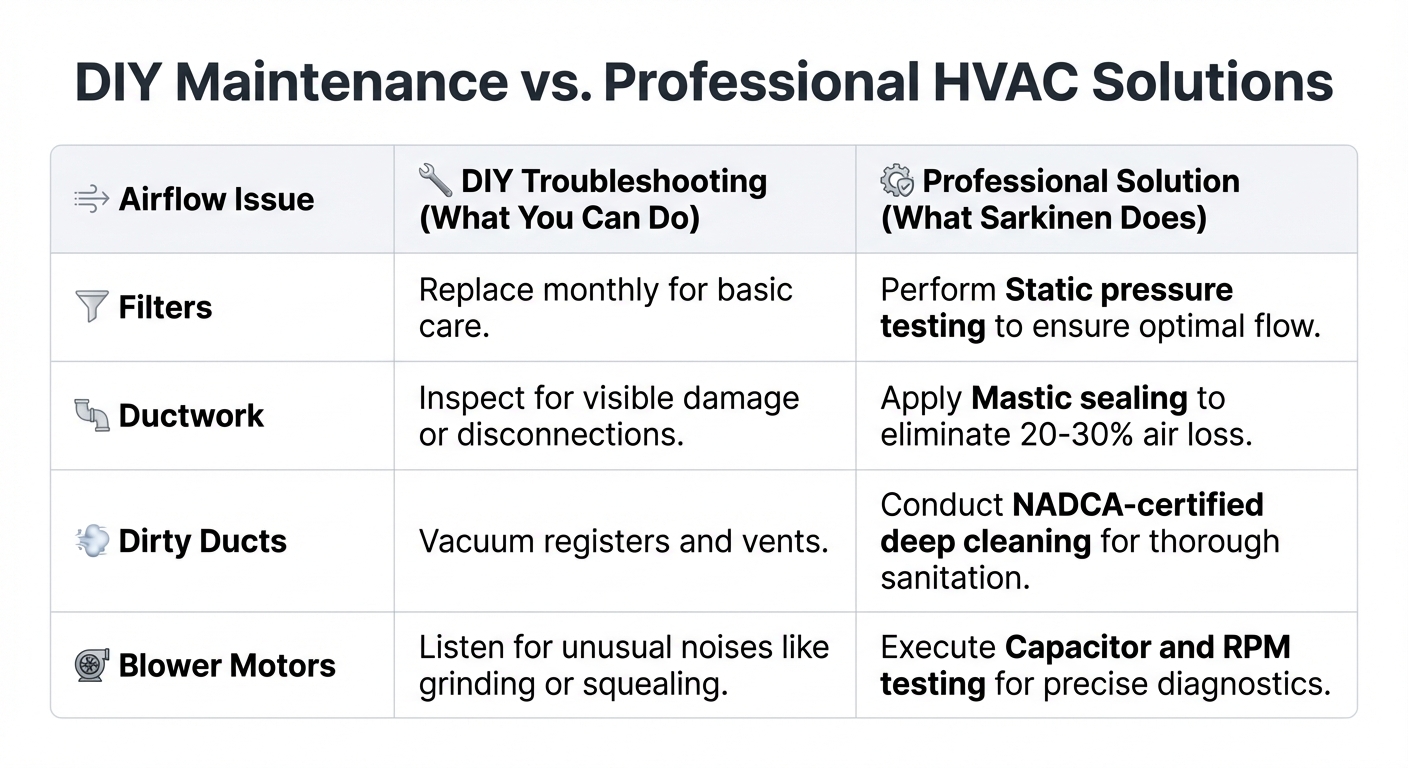
Your DIY Checklist:
- Check and replace your air filter. This should be your first step every time you notice reduced airflow. If the filter looks visibly dirty or it’s been more than three months since the last change, replace it immediately.
- Inspect visible ductwork in your basement, crawlspace, or attic. Look for obvious disconnections, crushed sections, or large gaps at connections. Don’t attempt repairs yourself, but identifying visible damage helps technicians diagnose issues faster.
- Listen for unusual sounds from your air handler. Squealing, grinding, or loud humming noises indicate mechanical problems that need professional attention. Note when the sounds occur and how long they last—this information helps technicians diagnose the issue.
- Verify all supply vents are fully open throughout your home. Closed or partially closed vents in unused rooms actually create problems by increasing static pressure. Your system is designed to distribute air to all installed vents.
When to Call Sarkinen Heating & Cooling:
- Weak airflow persists after replacing your filter and verifying vents are open
- You notice persistent temperature differences between rooms (some too hot, others too cold)
- Visible ductwork shows damage, disconnections, or heavy dust accumulation
- You hear unusual noises from your HVAC system
- It’s been more than three years since professional duct inspection or cleaning
- You’re experiencing higher energy bills without explanation
- Your system runs constantly but struggles to maintain temperature
What Sarkinen Heating & Cooling’s Professionals Provide:
Our comprehensive diagnostics go far beyond what homeowners can safely check themselves:
- Static pressure testing to identify system-wide airflow restrictions and pinpoint their exact location
- Video duct inspection using specialized cameras to identify hidden damage, blockages, or contamination deep within your duct system
- NADCA-certified duct cleaning using negative air machines and rotary brushes—the only approach proven to fully remove accumulated debris and restore optimal airflow
- Blower motor testing including capacitor performance measurement and electrical repairs to ensure your system operates at peak efficiency
- Professional mastic duct sealing that eliminates the 20% to 30% air loss typical homes experience from leaks and poor connections—repairs that last for decades
Key Takeaways
Weak airflow from your vents signals underlying problems that won’t resolve themselves. Whether it’s a clogged filter (the simplest fix), compromised ductwork stealing 20% to 30% of your conditioned air, years of accumulated debris creating friction inside your ducts, or a struggling blower motor on the verge of failure—each issue progressively damages your comfort, increases your energy bills, and shortens your HVAC system’s lifespan. Many airflow problems hide inside walls, ductwork, and mechanical components where homeowners can’t see them. That bedroom that’s always too hot in summer or freezing in winter? It’s not just an inconvenience—it’s your HVAC system signaling that it needs professional attention.
At Sarkinen Heating & Cooling, we’ve spent years mastering the specific challenges that Pacific Northwest HVAC systems face. We understand how the region’s climate affects your equipment, and we’ve invested in the diagnostic tools, professional training, and proven methods needed to restore optimal airflow and balanced comfort throughout your home. Your HVAC system represents a significant investment in your home’s comfort, air quality, and value. Don’t let hidden airflow issues drain your wallet, compromise your family’s comfort, and accelerate equipment wear. Whether you need comprehensive duct cleaning, precise diagnostics to identify that one troublesome room, or professional repairs to restore your system’s performance, we’re here to help.
Ready to Restore Comfort Throughout Your Home?
Tired of that one room that’s always too hot or too cold? Ready to stop paying to heat or cool your attic instead of your living spaces? Let Sarkinen Heating & Cooling restore balanced comfort throughout your home with professional airflow diagnostics and proven solutions.
Schedule Your Diagnostic Today
Or call us to speak with one of our HVAC specialists about your specific comfort concerns.
References:
- Pacific Northwest National Laboratory (PNNL). (2023). HVAC System Fundamentals and Static Pressure. https://www.pnnl.gov/building-energy-codes
- ASHRAE. (2022). Standard 62.2 – Ventilation and Acceptable Indoor Air Quality in Residential Buildings. https://www.ashrae.org/technical-resources/bookstore/standards-62-1-62-2
- U.S. Department of Energy (DOE). (2024). Maintaining Your Air Conditioner. https://www.energy.gov/energysaver/maintaining-your-air-conditioner
- ENERGY STAR. (2024). Duct Sealing: Improve Comfort and Efficiency. https://www.energystar.gov/saveathome/heating_cooling/duct_sealing
- U.S. Environmental Protection Agency (EPA). (2023). Should You Have the Air Ducts in Your Home Cleaned? https://www.epa.gov/indoor-air-quality-iaq/should-you-have-air-ducts-your-home-cleaned
- National Air Duct Cleaners Association (NADCA). (2024). Why Clean Air Ducts? The Benefits of Professional Cleaning. https://nadca.com/homeowners/why-clean-air-ducts
- U.S. Department of Energy (DOE) & Better Buildings. (2021). HVAC Maintenance Checklist and Efficiency Guidelines. https://betterbuildingssolutioncenter.energy.gov/
- Lawrence Berkeley National Laboratory (LBNL). (2022). Minimizing Energy Losses in Residential Ducts. https://homes.lbl.gov/